![1_entree_de_la_cour_ou_sont_les_pointes[1].JPG](https://static.wixstatic.com/media/88d3e2_72c92d9455d74ed1859fbb464c6284c1~mv2.jpg/v1/fill/w_980,h_653,al_c,q_85,usm_0.66_1.00_0.01,enc_avif,quality_auto/88d3e2_72c92d9455d74ed1859fbb464c6284c1~mv2.jpg)
Une seule
direction
vers le cosmos ?
Vladimir Skoda
Exhibition from December 12th 2022 to February 17th 2023
One direction only? (2004–2009)
For Vladimir Skoda, interaction is one of the tools used to visualize a reality that transcends human sensory perception. This action involves a displacement of objects beyond their physical reality into a virtual or astral space. Here, the combination of three site-specific sculptures, oriented towards the cosmos and scattered throughout the main courtyard, transforms and transports our gaze and our bodies into a space open to the cosmos. Vladimir Skoda likes to compare infinite dimensions with our environment, evoking a space that has the capacity to fill the entire universe, which exists everywhere, within reach and yet simultaneously inaccessible.

acier inoxydable poli miroir, 3 éléments, Ø 145 x 235 cm, Ø 145 x 215 cm, Ø 145 x 195 cm

acier inoxydable poli miroir, 3 éléments, Ø 145 x 235 cm, Ø 145 x 215 cm, Ø 145 x 195 cm

acier inoxydable poli miroir, 3 éléments, Ø 145 x 235 cm, Ø 145 x 215 cm, Ø 145 x 195 cm
acier inoxydable poli miroir, 3 éléments, Ø 145 x 235 cm, Ø 145 x 215 cm, Ø 145 x 195 cm
installation d’environ 200 000 des billes de roulement métalliques de 13,5 mm, étendues sur une surface horizontale

installation d’environ 200 000 des billes de roulement métalliques de 13,5 mm, étendues sur une surface horizontale

installation d’environ 200 000 des billes de roulement métalliques de 13,5 mm, étendues sur une surface horizontale
installation d’environ 200 000 des billes de roulement métalliques de 13,5 mm, étendues sur une surface horizontale
Aberrations – Entropia Grande, 1 – infinity (2011–2022)
Vladimir Skoda’s visual vocabulary has been built upon the exploration of simple geometric forms: spirals, cubes, polyhedra, and an alchemical relationship to matter. Since 1987, he has given pride of place to the motif of the sphere. Steel spheres, small and large, solid and perforated, raw or polished, animated or still, solitary or countless, and pendulums whose moving reflection is inscribed in a concave mirror, poetically express empirical views of the cosmos, linking physics and metaphysics. In 2010, Vladimir Skoda drew inspiration from optical and chromatic aberrations and created the series of photographs of the same name. He invoked the experiments of Joseph von Fraunhofer, the German optician and physicist. Thanks to the luminous reflections of the mirror-polished surface and the element of chance, he created his latest series, blending these two optical phenomena. His work, Entropia grande, 1 - infini, then serves as a medium for play and interaction. The work is visible in the first photograph presented in the Soufflot gallery, referencing the concept of entropy, which relates to chaos theory as well as the Big Bang theory, a cosmological model used by scientists to describe the origin and evolution of the Universe.
Born in Prague in 1942, Vladimir Skoda has lived and worked in Paris since 1968. In Vladimir Skoda's work, a recurring theme is the investigation of the myth of the cosmos: the symbolic union of life on earth and its places, and the abstraction of the omnipresent universe.

1994
Pieter Hugo
Exhibition from November 10th to December 11th 2022
Partnership with Photodays
"I began this series of images in Rwanda, but I was thinking about the year 1994, and the relationship between that country and South Africa over a period of ten or twenty years. I noticed that children, particularly in South Africa, don’t carry the same historical baggage as their parents. I find their engagement with the world refreshing in that they aren’t so burdened by the past, but at the same time, you see them growing up with certain ‘liberation narratives’ that are obviously, in some way, a fabrication. It’s almost as if you know something they don’t about the potential failures or possible shortcomings of these guiding narratives. Most of the photographs in this book were taken in villages in Rwanda and South Africa. The line is very thin between a nature considered idyllic and a place where terrible things can happen, steeped in genocide - a space that is constantly contested.” As a metaphor, it's as if the further you get from the city and its systems of control, the more primitive things become. Sometimes the children seem conservative, living in an ordered world; at other times, they have something wild about them, like in William Golding's Lord of the Flies: a place devoid of rules. This is particularly evident in the images from Rwanda, where clothes donated by Europe, with their specific cultural significance, are transposed into a completely different context. Being a parent myself has radically changed the way I see children. The challenge lies in creating unsentimental images. The act of photographing a child is so different - and in many ways much more difficult - than photographing an adult. The normal power dynamic between photographer and subject is subtly altered. I looked for children who already seemed to have well-formed personalities. There's an honesty and candor that can't be evoked any other way."
Pieter Hugo


Pieter Hugo, born in 1976, is a renowned South African photographer. He is widely recognized for his ability to capture powerful and provocative portraits, while exploring complex social and cultural themes through his artistic work. Among his most iconic series are "The Hyena & Other Men" and "Nollywood," which have been exhibited in internationally acclaimed galleries. Hugo's work offers a compelling perspective on the realities of life in Africa, addressing issues such as marginalization, identity, and the dynamics of contemporary society. His artistic work is a profoundly revealing reflection of the human condition and cultural diversity in Africa.

In visible
Esther Shalev-Gerz
From October 3rd to November 4th 2022
In Visible represents the absolute mystery of the universe: everything is different - every tree, every leaf, every person - and we don't know why. This work invites the viewer on a reflective and poetic journey into the deepest dimensions of the visible. Inspired by the passionate desire to discover the smallest state of matter through the latest advances in ultramicroscopy and the contemporary need for trust fostered by traceability and biometric technologies, In Visible offers an exploration of the most minute characteristics of what defines an identity and a reflective look at the unique visual attributes of an iris.

Images générées en 3D, pigments naturels sur papier d'archivage

Images générées en 3D, pigments naturels sur papier d'archivage

Images générées en 3D, pigments naturels sur papier d'archivage
Images générées en 3D, pigments naturels sur papier d'archivage
The iris, the quintessence of biometrics at a near-iconic level, impossible to photograph in its pure form, is the physical archive that bears the traces of a person's unique identity. This mysterious interface, with its power of instant seduction, is also the threshold between perceived and imagined reality. Through a spectacular change of scale, ten monumental and unique irises, created in 3D ex nihilo by the artist, reveal a color, an architecture, and a code as unique as each individual. Just as the magic of the world cannot be explained, the artist has assigned a different code to the construction of each iris. By approaching the surface, the viewer can explore the specificity of each iris and discover its identity system, a reflection of the changes taking place today in recognition systems.
Based in Paris, Esther Shalev-Gerz is internationally recognized for her fundamental contributions to public art and for her consistent inquiry into the construction of memory, history, the natural world, democracy, and cultural identities. Her works challenge the notion and practice of portraiture and examine how its qualities can contribute to contemporary discourse on the politics of representation.

POUR L'UKRAINE - ""La Madone Ukrainienne" / "Українська Мадонна"
MYKOLA HRYTSELYAK
From September 26th to 30th, 2022
Exhibition Curator : Varvara Karpechenkova
Opening on September 26th 2022
Sorbonne Artgallery is thrilled to present you the exhibition cycle called POUR L'UKRAINE. Its' third part titled "La Madone Ukrainienne" / "Українська Мадонна" is by artist Mykola Hrytselya.
POUR L'UKRAINE
Today in Ukraine, cities are being destroyed and entire regions of the country are being burned by infernal flames. The Russian occupiers are trying to steal Ukrainian youth, to destroy the world of young Ukrainians, a world that has been forged alongside the young state over the past thirty years.
In the last six months, everything has changed in Ukraine. Instead of the rhythms of nightclubs, the wail of sirens. Instead of the sounds of construction, the rumble of explosions. Life hangs on the edge, and the alarming sound grips minds.
The Sorbonne Artgallery is hosting a series of exhibitions this academic year featuring three Ukrainian artists. The works presented each manifest, in their own way, the new reality facing Ukrainians.
Contemporary Ukrainian artists reflect not only the violence and fear, but also the strength, will, and heroism of the Ukrainian people.
In Ukraine, the times have become similar to the era of "classical Greek tragedy," in which there is room for strong feelings, in which youth struggle for their future, in which art becomes a force of popular solidarity.


Young Ukrainian artists from different regions of Ukraine - South, West, and North - are trying to understand their place in the global cultural drama. New military narratives are shaping Ukrainian art, which is actively participating in the creation of a new era. Visual images can now move beyond the shouts of verbal outbursts and give way to a deeper analysis of history.
Mykola Hrytselyak (Lviv, Ukraine) - a Ukrainian monumentalist and graphic designer. In the series The Ukrainian Madonna he uses the plastic of the human body to record the inner tension and concentration of strong emotional states in times of war, despair, loss, grief, struggle...
He sees female nudity as a symbol of freedom and the energy of the struggle for Ukrainian identity. A certain incompleteness of his works transmits expression and impulse, giving the viewer space for reflection. Young Ukrainian artists from different regions of Ukraine: South, West and North try to understand their place in the world cultural drama. New military stories shape Ukrainian art which actively participates in the creation of a new era. Visual images can now move away from the screams of verbal outbursts and give way to in-depth story analysis.


Cycle of exhibitions
"For Ukraine"
Inna Kharchuk/Iryna Suchelnytska/Mykola Hrytselyak
Exhibition curator: Varvara Karpechenkova
Text: Savchenko Victor Anatoliyovych, Ukrainian history teacher and writer
From September 12 to 30, 2022
12, Place du Panthéon, Soufflot Gallery - Ground floor, 75005
Openings
RSVP required by email
sorbonneartgallery@univ-paris1.f
September 12 at 7 p.m.: Exhibition by Inna Kharchuk "Le Sol" / "Ґрунт"
September 19 at 7 p.m.: Exhibition by Iryna Suchelnytska "The voice of war" / "Голос війни"
September 26 at 7 p.m.: Exhibition by Mykola Hrytselyak "The Ukrainian Madonna" / "Українська Мадонна"

Inna Kharchuk, Chervoni choboty, 2021
For Ukraine
Today, in Ukraine, cities are destroyed and whole regions of the country are burned by infernal flames. The Russian occupiers are trying to steal Ukrainian youth, to destroy the world of young Ukrainians, which has formed with the young state for thirty years.
In the last six months, everything has changed in Ukraine - instead of the rhythms of nightclubs - the howl of sirens, instead of the noise of construction - the roar of explosions... Life hangs on the edge and the alarming sound controls minds.
The Sorbonne Artgallerywelcomes at the start of this school year the cycle of exhibitions with three Ukrainian artists. The works presented manifest, each to its own degree, the new reality facing Ukrainians.
Contemporary Ukrainian artists not only reflect violence and fear, but also the strength, will and heroism of the Ukrainian people.
In Ukraine, the times have become similar to the era of "classical Greek tragedy", in which there is a place for strong feelings, in which youth struggles for its future, in which art becomes a force of popular solidarity.
Inna Kharchuk(Volhynia, Ukraine), tries to find the Ukrainian cultural code through the prism of his individual feelings.
In his works, the artist explores the question of self-identification in society, as well as the themes of personal and collective memory, through his own experiences and reflections. Inna Kharchuk examines "ancestry" and "family", i.e. essential concepts in the context of events taking place in the country, which, in turn, characterize a series of works created by the artist.
To create a work of art, the artist examines archival photographs of Ukrainians from different regions to fully explore not only the unique and historical Ukrainian folklore, but also the historical context at the time of the creation of the artwork. artwork.
In the works ofIryna Suchelnytska(Odessa, Ukraine), the voice of pain and helplessness is heard through the prism of war. The artist's works reflect emotional reactions to military events stemming from the existential flow of resistance to the absurdity of total destruction.
The artist gives meaning to his direct experience of the encounter with war by interpreting the events in a mythopoetic way, in the same spirit as the Ukrainian Baroque. It emphasizes the cultural value of Ukrainian identity which is on the edge of the European world.
The voice of war is conveyed through a graphic aesthetic, a thin, energetic and nervously woven line that expresses excitement and anxiety. She transforms the line into a plastic form using contrast with a dark background, accentuating the drama of the perception of current events.
Mykola Hrytselyak(Lviv, Ukraine) - a Ukrainian monumentalist and graphic designer. In the series The Ukrainian Madonna he uses the plastic of the human body to record the inner tension and concentration of strong emotional states in times of war, despair, loss, grief, struggle...
He sees female nudity as a symbol of freedom and the energy of the struggle for Ukrainian identity. A certain incompleteness of his works transmits expression and impulse, giving the viewer space for reflection. Young Ukrainian artists from different regions of Ukraine: South, West and North try to understand their place in the world cultural drama. New military stories shape Ukrainian art which actively participates in the creation of a new era. Visual images can now move away from the screams of verbal outbursts and give way to in-depth story analysis.
Young Ukrainian artists from different regions of Ukraine: South, West and North try to understand their place in the world cultural drama. New military stories shape Ukrainian art which actively participates in the creation of a new era. Visual images can now move away from screams of verbal outbursts and make room for in-depth story analysis.

Iryna Suchelnytska,Incredibles, 2022

Mykola Hrytselyak, La Ukrainian Madonna, 2022

Inna Kharchuk, view of the exhibition in the gallery, 2022

Inna Kharchuk, view of the exhibition in the gallery, 2022


POUR L'UKRAINE - "La voix de la guerre" / "Голос війни"
IRYNA SUCHELNYTSKA
From September 19th to 25th, 2022
Exhibition Curator : Varvara Karpechenkova
Opening on September 19th 2022
Sorbonne Artgallery is thrilled to present you the exhibition cycle called POUR L'UKRAINE. Its' second part titled "La voix de la guerre" / "Голос війни" is by artist Iryna Suchelnytska.
POUR L'UKRAINE
Today in Ukraine, cities are being destroyed and entire regions of the country are being burned by infernal flames. The Russian occupiers are trying to steal Ukrainian youth, to destroy the world of young Ukrainians, a world that has been forged alongside the young state over the past thirty years.
In the last six months, everything has changed in Ukraine. Instead of the rhythms of nightclubs, the wail of sirens. Instead of the sounds of construction, the rumble of explosions. Life hangs on the edge, and the alarming sound grips minds.
The Sorbonne Artgallery is hosting a series of exhibitions this academic year featuring three Ukrainian artists. The works presented each manifest, in their own way, the new reality facing Ukrainians.
Contemporary Ukrainian artists reflect not only the violence and fear, but also the strength, will, and heroism of the Ukrainian people.
In Ukraine, the times have become similar to the era of "classical Greek tragedy," in which there is room for strong feelings, in which youth struggle for their future, in which art becomes a force of popular solidarity.


Young Ukrainian artists from different regions of Ukraine - South, West, and North - are trying to understand their place in the global cultural drama. New military narratives are shaping Ukrainian art, which is actively participating in the creation of a new era. Visual images can now move beyond the shouts of verbal outbursts and give way to a deeper analysis of history.
In the works of Iryna Suchelnytska (Odessa, Ukraine), the voice of pain and helplessness is heard through the prism of war. The artist's works reflect emotional reactions to military events stemming from the existential flow of resistance to the absurdity of total destruction.
The artist gives meaning to her direct experience of the encounter with war by interpreting the events in a mythopoetic way, in the same spirit as the Ukrainian Baroque. It emphasizes the cultural value of Ukrainian identity which is on the edge of the European world.
The voice of war is conveyed through a graphic aesthetic, a thin, energetic and nervously woven line that expresses excitement and anxiety. She transforms the line into a plastic form using contrast with a dark background, accentuating the drama of the perception of current events.

Cycle of exhibitions
"For Ukraine"
Inna Kharchuk/Iryna Suchelnytska/Mykola Hrytselyak
Exhibition curator: Varvara Karpechenkova
Text: Savchenko Victor Anatoliyovych, Ukrainian history teacher and writer
From September 12 to 30, 2022
12, Place du Panthéon, Soufflot Gallery - Ground floor, 75005
Openings
RSVP required by email
sorbonneartgallery@univ-paris1.f
September 12 at 7 p.m.: Exhibition by Inna Kharchuk "Le Sol" / "Ґрунт"
September 19 at 7 p.m.: Exhibition by Iryna Suchelnytska "The voice of war" / "Голос війни"
September 26 at 7 p.m.: Exhibition by Mykola Hrytselyak "The Ukrainian Madonna" / "Українська Мадонна"
Inna Kharchuk, Chervoni choboty, 2021
For Ukraine
Today, in Ukraine, cities are destroyed and whole regions of the country are burned by infernal flames. The Russian occupiers are trying to steal Ukrainian youth, to destroy the world of young Ukrainians, which has formed with the young state for thirty years.
In the last six months, everything has changed in Ukraine - instead of the rhythms of nightclubs - the howl of sirens, instead of the noise of construction - the roar of explosions... Life hangs on the edge and the alarming sound controls minds.
The Sorbonne Artgallerywelcomes at the start of this school year the cycle of exhibitions with three Ukrainian artists. The works presented manifest, each to its own degree, the new reality facing Ukrainians.
Contemporary Ukrainian artists not only reflect violence and fear, but also the strength, will and heroism of the Ukrainian people.
In Ukraine, the times have become similar to the era of "classical Greek tragedy", in which there is a place for strong feelings, in which youth struggles for its future, in which art becomes a force of popular solidarity.
Inna Kharchuk(Volhynia, Ukraine), tries to find the Ukrainian cultural code through the prism of his individual feelings.
In his works, the artist explores the question of self-identification in society, as well as the themes of personal and collective memory, through his own experiences and reflections. Inna Kharchuk examines "ancestry" and "family", i.e. essential concepts in the context of events taking place in the country, which, in turn, characterize a series of works created by the artist.
To create a work of art, the artist examines archival photographs of Ukrainians from different regions to fully explore not only the unique and historical Ukrainian folklore, but also the historical context at the time of the creation of the artwork. artwork.
In the works ofIryna Suchelnytska(Odessa, Ukraine), the voice of pain and helplessness is heard through the prism of war. The artist's works reflect emotional reactions to military events stemming from the existential flow of resistance to the absurdity of total destruction.
The artist gives meaning to his direct experience of the encounter with war by interpreting the events in a mythopoetic way, in the same spirit as the Ukrainian Baroque. It emphasizes the cultural value of Ukrainian identity which is on the edge of the European world.
The voice of war is conveyed through a graphic aesthetic, a thin, energetic and nervously woven line that expresses excitement and anxiety. She transforms the line into a plastic form using contrast with a dark background, accentuating the drama of the perception of current events.
Mykola Hrytselyak(Lviv, Ukraine) - a Ukrainian monumentalist and graphic designer. In the series The Ukrainian Madonna he uses the plastic of the human body to record the inner tension and concentration of strong emotional states in times of war, despair, loss, grief, struggle...
He sees female nudity as a symbol of freedom and the energy of the struggle for Ukrainian identity. A certain incompleteness of his works transmits expression and impulse, giving the viewer space for reflection. Young Ukrainian artists from different regions of Ukraine: South, West and North try to understand their place in the world cultural drama. New military stories shape Ukrainian art which actively participates in the creation of a new era. Visual images can now move away from the screams of verbal outbursts and give way to in-depth story analysis.
Young Ukrainian artists from different regions of Ukraine: South, West and North try to understand their place in the world cultural drama. New military stories shape Ukrainian art which actively participates in the creation of a new era. Visual images can now move away from screams of verbal outbursts and make room for in-depth story analysis.
Iryna Suchelnytska,Incredibles, 2022
Mykola Hrytselyak, La Ukrainian Madonna, 2022
Inna Kharchuk, view of the exhibition in the gallery, 2022
Inna Kharchuk, view of the exhibition in the gallery, 2022

POUR L'UKRAINE - "Le Sol" / "Ґрунт"
INNA KHARCHUK
From September 12th to 18th, 2022
Exhibition Curator : Varvara Karpechenkova
Opening on September 12th 2022
Sorbonne Artgallery is thrilled to present you the exhibition cycle called POUR L'UKRAINE. Its' first part titled "Le Sol" / "Ґрунт" is by artist Inna Kharchuk.
POUR L'UKRAINE
Today in Ukraine, cities are being destroyed and entire regions of the country are being burned by infernal flames. The Russian occupiers are trying to steal Ukrainian youth, to destroy the world of young Ukrainians, a world that has been forged alongside the young state over the past thirty years.
In the last six months, everything has changed in Ukrain. Instead of the rhythms of nightclubs, the wail of sirens. Instead of the sounds of construction, the rumble of explosions. Life hangs on the edge, and the alarming sound grips minds.
The Sorbonne Artgallery is hosting a series of exhibitions this academic year featuring three Ukrainian artists. The works presented each manifest, in their own way, the new reality facing Ukrainians.
Contemporary Ukrainian artists reflect not only the violence and fear, but also the strength, will, and heroism of the Ukrainian people.
In Ukraine, the times have become similar to the era of "classical Greek tragedy," in which there is room for strong feelings, in which youth struggle for their future, in which art becomes a force of popular solidarity.


Young Ukrainian artists from different regions of Ukraine - South, West, and North - are trying to understand their place in the global cultural drama. New military narratives are shaping Ukrainian art, which is actively participating in the creation of a new era. Visual images can now move beyond the shouts of verbal outbursts and give way to a deeper analysis of history.
Inna Kharchuk (Volhynia, Ukraine), tries to find the Ukrainian cultural code through the prism of his individual feelings.
In her works, the artist explores the question of self-identification in society, as well as the themes of personal and collective memory, through his own experiences and reflections. Inna Kharchuk examines "ancestry" and "family", i.e. essential concepts in the context of events taking place in the country, which, in turn, characterize a series of works created by the artist.
To create a work of art, the artist examines archival photographs of Ukrainians from different regions to fully explore not only the unique and historical Ukrainian folklore, but also the historical context at the time of the creation of the artwork.


An iconography of movement
Jean Gottmann
Exhibition curator : Yann Toma
Exhibition from July 18th to September 2nd 2022
Half of the photographs on display were taken in North America, a third in Europe, 10-15% in Latin America, while the remaining 5% consist of diagrams, maps and artwork. The collection, which is not limited to a traditional geographical study, includes field photos, personal, professional and intellectual elements, as well as material from previous projects. The mixture of his work in the field and his intellectual and professional life through his "Atlantic transhumance" reveals his vision of the variety of human geography.
Beyond the documentation of transatlantic landscapes, the collection also traces his intellectual transition from the French regional monograph to an innovative understanding of the territory, which for him consists of a multiscalar geography of nodes and networks, informed by the cultural and psychological projection of the peoples who share it as a common habitat. It also follows his early discovery of the symbiosis between the rural and the urban on the northeast coast of the United States, which, for J. Gottmann, was the hinge of a complex network. Going beyond the limits of national frameworks of political geography, Jean Gottmann questioned the possibility of a global community in the future, considering that a planetary political organization would function on condition of respecting the cultural variety of the world. Thus, his work becomes even more interesting - and important - in today's troubled times.


This is a paragraph area where you can add your own text. Click "Edit text" to add your content. It's a great place to tell a story about your business and let users learn more about you.
J. Gottmann's never-before-exhibited landscapes, many of which were photographed "on the road" or in the street, offer vivid glimpses of people and places, highlighting his attraction to the cultural diversity of human settlements. They reflect his unique approach to geography: landscapes are a living theater. These "living theaters" transcend pure geography: they reveal an artistic vision.
Presented from July 18 to September 2, the exhibition is part of the official program of the International Geographical Union (IGU) Centenary Congress, organized by the French Committee of Geography (CNFG) from July 18 to 23, 2022. On the morning of the exhibition's opening, July 19, a plenary session dedicated to Jean Gottmann and his photographic collection was held in Room 307 of the Panthéon Center. The catalogue, Jean Gottmann: An Iconography of Movement, was edited by Olivier Labussière & Luca Muscarà, Olivier Loiseaux, Jean-Paul Hubert, Anne-Laure Amilhat Szary, Yann Toma, and Louise Hantson, and published by Jannink Editions. It includes contributions from Andrea Masala (Pacte) and Nicolas Tixier (ENSAG-AAU-Cresson).
Interns in charge of the exhibition: Marthe Beseme, Gladys de Cambourg and Lulu Fleming-Benite.


Jean Gottmann (1915–1994) was a visionary geographer whose work helped shape our understanding of urban landscapes. Gottmann was much more than a cartographer; he was an artist of geography, capturing the complexity of cities through his meticulous observations.
Through his maps, drawings, and photographs, Jean Gottmann transcended the boundaries between art and science, offering a unique perspective on urbanism. His iconic work, "Megalopolis: The Urbanized Northeastern Seaboard of the United States," has been a starting point for numerous discussions on urban growth and land-use planning.
His drawings and photographs, often exhibited worldwide, invite us to consider the hidden geometry of cities, how they grow, breathe, and evolve. By highlighting the complex interaction between people and their environment, Gottmann reminded us that every city is a work of art in perpetual flux.


L'illusion
est la première apparence
de la vérité
Decebal Scriba
From June 1st to July 13th 2022
Exhibition curator : Ami Barak
In the 1970s and 80s, Decebal Scriba used the image as evidence for a conceptual axiom. Now an overwhelming horde, the omnipresent image in our lives gives photography a prodigious ubiquity and a prominent place in everyone's practices. Traditionally considered a reproduction of reality, the photographic image, as practiced by the artist, is today deconstructed, reconstructed, and questioned. For Decebal Scriba, this document of everyday life is neither a marker of reality nor an objective capture of the world. It is the tender pursuit of a detail or a mechanism, to which his gaze has subtly attributed the power of symbol and metaphor, with an undeniably potent poetic quality.
Given the particular configuration of the exhibition space, the artist insisted that his works be placed within the alcoves and panels that punctuate the gallery. For this reason, layouts were created, each grouping images that share a common thematic denominator. Thus, we find three images of different wear marks on a concrete floor, their lyrical abstraction undeniable. Just as during walks in the forest, the camera captured branches whose arrangement seems to belong to an abstract, post-land art grammar. Halos of white light on walls plunged into semi-darkness reveal striking, intimate boreal halos, as well as the various types of daytime and nighttime light patches that only the camera can freeze. In abandoned interiors, the artist became enamored with the signs of destruction and wear that reveal a purely plastic aesthetic logic. Lines, intersections, and spirals drawn on the asphalt as construction sites unfold are, for Decebal Scriba, visual haikus that evoke a constructivist lexicon. Through these montages, we become aware of the underlying designs of the artist who was captured in his environment or his wanderings of all these unforeseen artistic and visual events.
Decebal Scriba (RO/FR) is an artist approaching many different media such as drawing, photography, installation, performance and video art, with sustained activity in the sphere of conceptual art. He lives and works in France since 1991.
“The coordinates of his works open up many levels, including, on the one hand, that of the analysis of the systems of representation and production and reproduction of space, alongside that of the conceptualization of the (visual, mathematical and textual) signification systems and, on the other hand, at the level of a private, interiorized and nearly existential assumption of the artistic act.” (Cristian Nae, A Field of Possibilities - Decebal Scriba and The Semiotics of Appearance)
In the 70's and 80's Decebal Scriba used the image as an evidence of a conceptual axiom. Now an invading horde, the pervasive image in our lives gives photography a prodigious ubiquity and a key place in the practices of everyone. Traditionally considered as the reproduction of reality, the photographic image as practiced by the artist, is today decomposed, recomposed, questioned. For Decebal Scriba this document of the daily life, is not marker of reality and not more objective capture of the world. It is the tenderized hunt of a detail or a gear whose look has subtly attributed to it a strong message as symbol and metaphor with an undeniably powerful poetic quotient.
Given the particular configuration of the exhibition space, the artist wanted that his works take place in the cells and panels that articulate the gallery. For this reason, layouts have been made, which brings together each time images that have a common denominator. Thus we find four images of different stains of wear of a concrete floor whose quotient of lyrical abstraction is noticeable. Just as during the walks in the forest, the camera has captured branches whose arrangement seems to be part of a post land art abstract grammar. Halos around light sources on walls plunged into shadow reveal striking intimist aurora borealis but also the different types of day or night light spots that only the camera has the power to freeze. In the interiors left fallow, the artist has fallen in love with the signs of destruction and wear and tear that reveal a totally plastic aesthetic logic. Lines, crossings and spirals drawn on the asphalt in the course of construction sites are for Decebal Scriba visual haikus that remind us of a constructivist lexicon. In the course of these layouts we realize the subjacent designs of the artist who was seized, in his environment or his wanderings, all these unforeseen visual arts.
Ami Barak


Decebal Scriba was born in 1944 in Romania. He lives and works in Fontainebleau-Avon. A Romanian artist who arrived in France in 1991, Decebal Scriba distinguished himself during the 1970s and 80s as a leading figure in contemporary art. His work is now considered emblematic of a post-war Romanian avant-garde. Through a coherent body of work developed using diverse media - photography, installation, performance, and video art - the artist explores conceptual and performative art, questions of formal and textual language, spatial representation, and the symbolism of gestures and forms. The sign is omnipresent in his work, referring to handwritten, bodily, mathematical, and cultural language. It thus becomes the vehicle for philosophical and political reflections, questioning our relationship to others and to art.


Polyptique
d'un Polycorps
Faust Cardinali
From April 26th to May 27th 2022
Exhibition curator : Yann Toma
Faust Cardinali, with this polyptych from the Sorbonne, elucidates or hides even more the history of the discovery of his polyvinyl raw material. With a singular sense of covering the landscape, of resistance to the persistence of the (found) object, of reflection on the place of the animal today, of positioning architecture with regard to the environment, the artist offers a very personal conception of the museum to finally manage to address the notion of scale and dimension of the work. It is a question here of re-examining the notion of sculpture at a moment in our history when all relief seems to be abolished in fact. Would the shift from polyptych to polybody announce a new body?

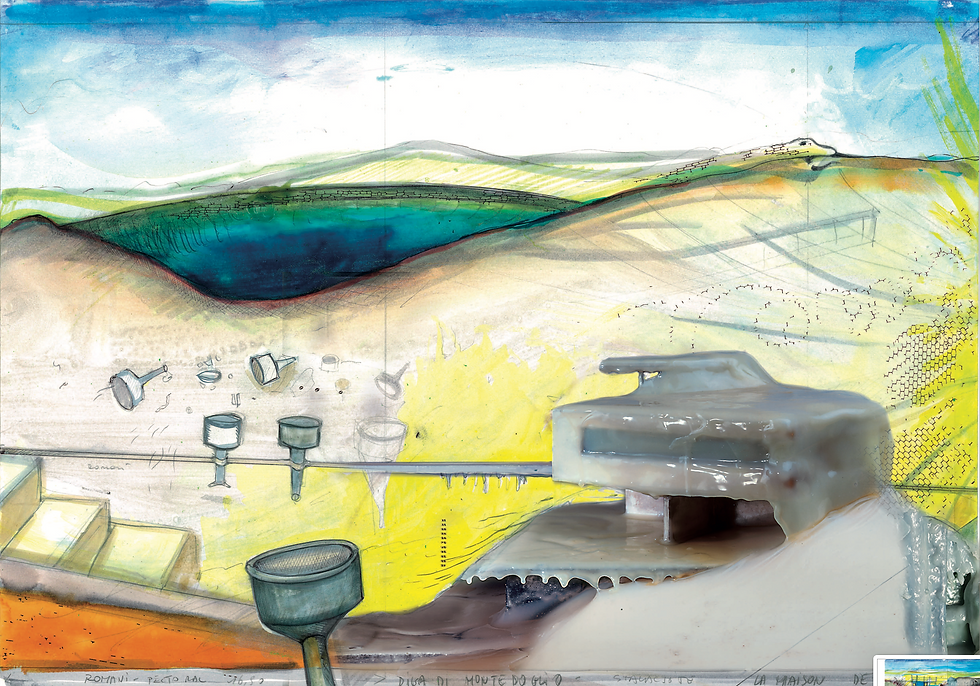
Polyptych, the nine images presented, are a kind of tracking shot through my previous work and simultaneously into a future project, a long landscape where plastic, organic, metallic, and architectural (and therefore also textual) materials sketch a world where humankind is physically absent but psychologically present. It is about staging several stories within a new narrative of images. The descriptions of the works give no indication of size or proportion. What one might call an "artist's jewel" is an immense sculpture, a monumental installation that suddenly becomes minuscule, a painted landscape transformed into a miniature. The most recent works are juxtaposed with historical pieces; models built in the 1960s, 70s, and 80s in a renowned French architectural firm have become stalactite-like cities. Animal skulls and bones, found over the past ten years during wanderings in the Tuscan woods, take on the appearance of hybrid sculptures. The idea is to dissolve the hierarchies between disciplines, to paint a resin landscape onto a real one, to revitalize classical metalwork, where the precious becomes color and is integrated into the artwork, as in the past, in painting, when natural pigments were mixed with oil paints. In this case, the precious is the very substance of the paint… The installations, the monuments to come, take into account this time of making, this malleable material.
Faust Cardinali
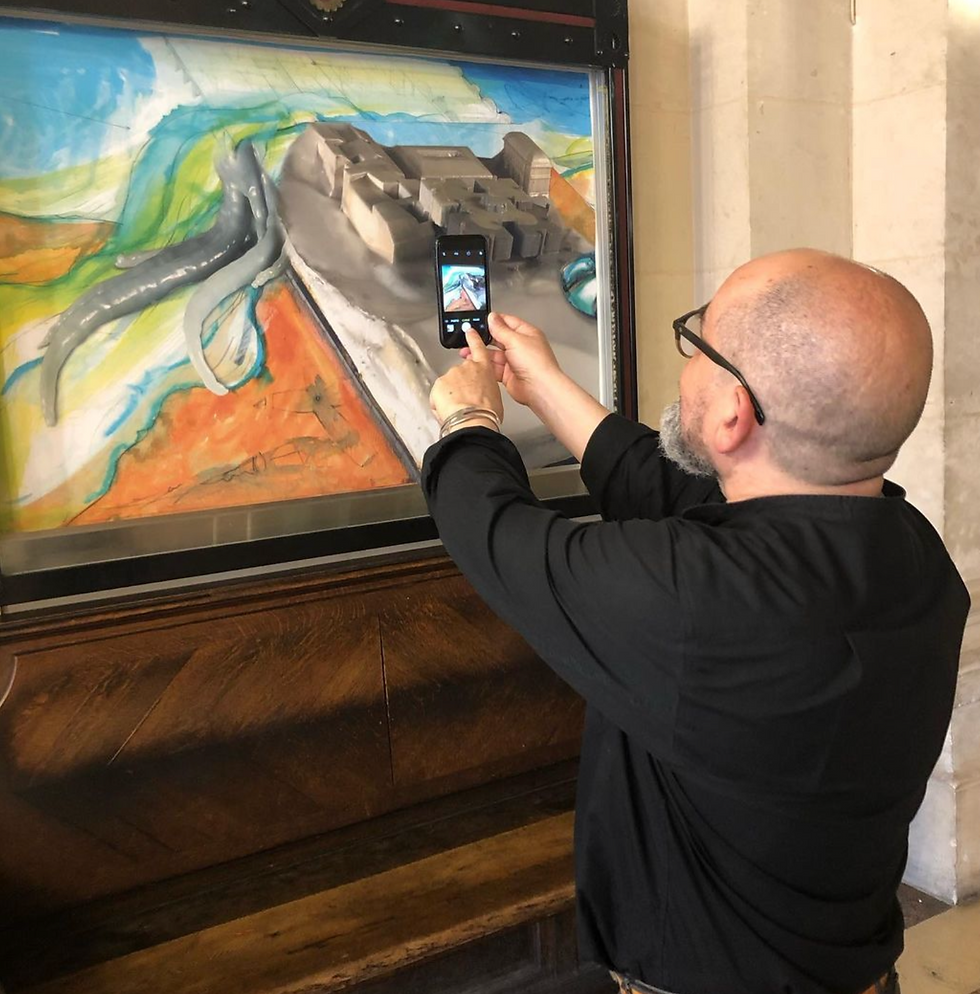


Faust Cardinali practices three art forms simultaneously: painting, sculpture, and goldsmithing. Each influences the others.
His jewelry often serves as an object that explains and reveals the other disciplines, sometimes in an exaggerated way - the jewelry decoding the message while the painting inscribes it. His work, addressing the extreme violence of the raw material, contrasts with the refinement, even the grace, of the final result. For over thirty years, Faust Cardinali has explored the idea of a society transformed by the ideal forms of stalagmites and stalactites. The passage of time is organically a non-toxic plastic - for these polybodies are living beings, conceived through a loving encounter between humans. The resin that flows from the pictorial space is symbolically sap, an organic, plastic, and semantic matter. The science-fiction aesthetic evokes a form of repurposed archaeology: the plasticized architectures are inhabited by absent resistance fighters; the original models by architects Andrault and Parat, from the 1960s and 70s, recovered by the artist, were immersed in resin for an indefinite period and became sprawling sculptures, metaphysical and organic in appearance. The artist has repurposed the architects' original project of building dwellings, giving it new life and transforming it into a fully-fledged sculptural work. In Faust Cardinali's working process, a ritual of transformation appears as a manifesto for liberating actions, from a body that is still human but already cyborg, also a tool that triggers installations. "The artist's jewel can become a paintbrush, a paperclip, a screwdriver; it is an adornment or a shield; it is on the same level as a Picasso painting!" It is no longer decoration or accessory but art in its own right.” Part of the polyptych that it is, Cardinali is a polycorpus.


Plein air
Jérémie Danon,
Lauréat du Prix AMMA
Exhibition curator : Mathilda Portoghese
From March 14th to April 1sth 2022 - From April 11th to 23rd 2022
Plein Air features individuals undergoing reintegration. Released from prison, they now find themselves in a freedom different from the one they knew before their incarceration. Transformed by their experience of captivity, they see this rediscovered world in a new light, where they encounter the harshness of a system ill-suited to their situations and the limited employment opportunities it offers. After spending time with them, Jérémie Danon invited these former inmates to appear against a green screen; this technique allows him to present them while simultaneously decontextualizing them from reality, using imaginary spaces. From the mythopoetic universe of Falkreath in The Elder Scrolls to that of the action-adventure game GTA V, these computer-generated video game settings were chosen based on their answers to the question: "Where would you like to be now?" Their lush, virtual landscapes contrast sharply with both the past captivity of these individuals and the new hostility of the concrete jungle. After inviting five former inmates to speak against a green screen, the artist extends his video work by inviting the remaining participants to integrate these imaginary spaces into a series of photographs taken with a large-format camera. To achieve this, and in keeping with the collaborative nature of his practice, Jérémie Danon enlisted the help of photographer Jules Séverac, a long-time friend and collaborator with whom he has worked on several projects. The series, currently composed of 16 photographs, also reveals the studio and its green screen, allowing for a comparison between the technical setup and the final result. The Plein Air (Outdoors) photo series is an invitation to juxtapose the photographic apparatus with the imagination when the latter is the only thing one possesses to escape reality.
Mathilda Portoghese


The AMMA Prize aims to highlight and promote emerging contemporary design. The 2022/2023 cohort of our Master's program is eager to hold a seventh edition of this event, which will take place at the Bastille Design Center (Paris, 11th arrondissement), a historic venue generously loaned to us each year. Fifteen candidates, pre-selected by the association's members, will have the opportunity to have their work exhibited there from February 16th to 18th, 2023.

I am interested in the individual, their identity, and the place society gives them. I meet people and forge connections.
I immerse myself in worlds that are not initially my own. From these relationships arise the observations and questions that form the basis of my work. I try to capture the time spent and the moments shared together through sound recording, photography, and video, which allow me to present a voice and a story very directly. The resulting work is not simply documentation but the transposition of a shared experience, presented in the form of an installation.
These texts were co-written by Jérémie Danon and Mathilda Portoghese


Rien ne résiste au soleil
Laure Tiberghien
Exibition curator : Olivier Schefer
Exibition from March 14th to April 1st 2022
It is invaluable to listen to an artist speak about their work, especially when something eludes them, slips into the margins, and tightens on a thin boundary. Laure Tiberghien's practice oscillates between technical mastery in the darkroom (she doesn't shoot directly from the camera) and an attentiveness to the emergence of accidental events, what she calls "leaks." The artist situates her artistic practice within the history of cameraless photography - August Strindberg's celestographs, the cyanotypes of botanist Anna Atkins - and it is also close to pictorial monochrome and certain painters of the Color Field movement; one often thinks here of Mark Rothko's canvases. Having come to photography through painting, Laure Tiberghien works in the darkness of her studio to reveal luminous horizons on the sensitive paper she manipulates using pieces of colored gelatin.
It was in this way that she one day observed the green border surrounding some of her works. Like the imperceptible frame of a Sam Francis canvas, these thin colored lines - a result of her experimentation - immediately intrigue her. What is there to see here? The artist calls this ray a "ray," in homage to the green ray: the last glimmer of the sun at sunset, which appears when certain atmospheric conditions are favorable. This green ray, first described by sailors, has haunted literature, from Jules Verne to Blaise Cendrars, as well as cinema and the visual arts. It is both real and imagined. A green flash, the English say, lasting a quarter of a second. Its reality is almost mythical; the green ray is a true utopia, a dream of light that few of us have actually seen.
Laure Tiberghien seizes upon it to photograph an imaginary line, that of an unreal and continuous horizon, which is both visible and perceptible within the Sorbonne gallery's exhibition. As if the artist were telling us that we cannot perceive a horizon unless we physically experience it, that of a landscape to traverse and feel. The invisible world lies at the edge of the real world, just as the horizon recedes as we approach it.
Nothing can resist the sun: the power of the major star within the very heart of darkness. Laure Tiberghien's photographs, in the thick blackness of the paper, open the promise of an unknown path. Her green line reminds us of those mesmerizing roads that unfold at night under car headlights, roads we perceive in a trance-like state, between wakefulness and dreaming.
A graduate of the Beaux-Arts de Paris in 2016, Laure Tiberghien lives and works in Paris. In 2017, she was invited by Françoise Paviot to hold her first solo exhibition, La Société Lumière, at the Espace Van Gogh in Arles. In 2018, she undertook a residency in the Agafay Desert at La Pause Residency. That same year, she was invited by the artist Eric Poitevin to exhibit at ArTsenal, the art center in Dreux, alongside six other artists. In February 2019, the Lumière des Roses gallery invited her for a solo exhibition. She was a co-recipient of the Louis Roederer Discovery Award at the Rencontres d’Arles photography festival in July 2019. Following this, her work entered the collections of the Rencontres d’Arles and subsequently those of the Musée français de la Photographie (French Museum of Photography). In 2020, she participated in the exhibition "Photography Tested by Abstraction" at the Centre Photographique d’Ile de France and the FRAC Normandie. That same year, the Centre Pompidou acquired three of her works. Laure Tiberghien explores the limits of the photographic medium by questioning its two fundamental elements: light and time. She also works with moving images in relation to still images. Using these elements, she creates photographic or filmic objects that are unreproducible and therefore unique.

LUIGIA RIVA, DAVIDE NAPOLI, GÉRALDINE HILAIRE
INVIDENZA
March 11th 2022
Exibition Curator : Yann Toma
Performance on March 11th 2022
Sorbonne Artgallery is thrilled to present you INVIDENZA , a performance by Luigi Riva, Davide Napoli and Géraldine Hilaire.
The word “Invidenza” in Italian and “Invidence” in French, originates from a text by Davide Napoli, an excerpt from his book “Le lapsus de l’ombre” (The Slip of the Shadow), published by Unicité, 2020, Paris.
This performance, conceived by Luigia Riva and Davide Napoli, draws inspiration from this text and finds points of convergence and divergence with the artistic space of Sorbonne Artgallery in its theoretical and practical exploration.
INVIDENZA is the interplay between the visible and invisible aspects of the body(ies) transported into an awareness of elsewhere, always present, and in perpetual motion between presence and absence.
Luigia Riva, Davide Napoli, and Geraldine Hilaire follow a vertiginous slide of bodies through a space-time continuum where reference points are lost.
The performance aims to be a kind of blurred perception of the world, a vision of existence as a lost inhabitant of our time.


PERFORMANCE DESCRIPTION
Three bodies in resonance: Luigia, Davide, and Geraldine. Text and movement in the space of Sorbonne Artgallery, with possible audience participation during the performance.
TECHNICAL ASPECTS
Duration: 30 minutes
Three lecterns
Spotlights
Recorded soundtrack
Speakers (two or three) placed along the gallery space
SOUNDTRACK CREATION
Sébastien Petit
BODY IN ACTION
Luigia Riva: choreographer and dancer
Davide Napoli: writer and performance artist
Géraldine Hilaire: actress and dancer
Dancer and choreographer Luigia Riva founded her company "Inbilico" (Unstable Balance) in 2000, with which she has created around twenty shows and performances.
Her choreographies and performances, at the intersection of visual arts and dance, have been presented in France at the Théâtre National de la Danse Chaillot, Parades for FiAC, Centre Pompidou, the Opéra de Nancy, Le Tarmac, the Centre National de la Danse, the Musée d'Art Moderne de Paris, Nuit Blanche, and the Palais de Tokyo. Her choreographies have also been programmed in France, Japan, Italy, Belgium, Switzerland, the Netherlands, Senegal, India, Syria, and Tunisia.
Alongside her career as a dancer and choreographer, Luigia teaches dance and the Alexander Technique, both individually and in groups. She was a teacher at the Ballet de Lorraine from 2005 to 2012. In 2022, she began training in the Bates Technique. Since 2019, she has taught Public Speaking at Sciences Po Paris.
Writer and visual artist Davide Napoli explores the performative forms of thought, drawing, and writing, with a poetic exploration of emptiness, time, the phantom, voidness (the speed of emptiness), the otherness of excess, fantasy, the plastic (a fusion of the plastic and the epistemic), black light, the otherness of uchronia, and the echoes of the unconscious. He holds doctorates in Philosophy and in Arts and Sciences of Art. He teaches Visual Arts at Paris 1 Panthéon-Sorbonne University and is a Professor of Methodologies and Techniques of Contemporary Art at the Academy of Fine Arts in Palermo, Italy. Member of the Art & Flux and Art and Care research teams, ACTE Institute (UMR 8218, CNRS, Sorbonne).
He worked between 2002 and 2006 with contemporary dance, the company Les Gens d’Uterpan, and most recently in 2015 with Anatoli Vlassov and in 2016 with Isabelle Maurel, choreographers and dancers. He recently published *VIDESSE, la vitesse du vide* (Videsse, the Speed of Emptiness) with Éditions TRANSIGNUM, and his latest text/drawing performances took place at Espace Rue Française and Galerie Vincez Sala in Paris in 2015/2016.
Dancer, choreographer, actress, author, and storyteller, Géraldine Hilaire follows in an artistic tradition and began her artistic journey very early. From the sixth grade onward, she studied Corneille's *Le Cid* and passionately immersed herself in the world of words. The texts then become bursts of imagination, gentle enchantments, miracles to be breathed in from the depths of one's being.
At the age of 17, she entered the Conservatory. Encouraged by Claire Sombert, the director of the Conservatory, Géraldine Hilaire played La Sylphide in Musset's *La Muse*. The young artist definitively dedicated herself to dance and its lush, ethereal qualities.
Very quickly, she began taking acting classes at Verbe et Lumière with Dominique Leverd, who introduced her to the great texts. There, Géraldine Hilaire learned to connect with the author by starting with their style.
With this actor-director, she discovered excellent actor direction and learned to inhabit the works of Corneille, Racine, Anouilh, and Montherlant, always remaining at the service of the authors.
Hired by the Théâtre des Nymphes company, Géraldine Hilaire is directed by Virginie Haudricourt. In "The Journey to Lice Country," this children's show, the young actress embodies eight successive roles. From Cinderella to Beauty and the Beast, she draws on dance improvisation, theater, and relaxation techniques. Set to the music of René Aubry, she discovers the grace and boundless femininity of Carolyn Carlson. At the Conservatory, with her theater teacher Stéphan Druet, she had already been introduced to these artistic stagings, and choreography becomes the first realization of her dream.


Documenta XV + I
Cannelle Tanc & Frédéric Vincent
The piece titled documenta XV+I is a collaborative work by Cannelle Tanc and Frédéric Vincent. It was first presented at the Kunstlerhaus Frize in Hamburg in 2007, during documenta 12 in Kassel, under the title documenta XII + I. This piece consists of large prints displayed on the walls. These large digital prints represent the names of the various artistic directors and artists who participated in the different documenta exhibitions. The names of men are highlighted in blue, those of women in pink, and mixed-gender groups or collectives of artists in purple. This installation immerses the viewer in the history of the documenta event. The viewer witnesses the evolution of artistic practices, as well as the subtle transition from modern to contemporary art. They become a witness to change and evolving social norms. For the first four documenta exhibitions, we observe a significant amount of blue on the walls and very little pink. It wasn't until documenta 10 that the curator was a woman, Catherine David in this instance. From 1955, the year of the first documenta, to 1997, the year of documenta 10, it took 42 years for a woman to curate the exhibition. Contemporary art made its appearance at documenta 5 in 1972, organized by Harald Szeemann. At documenta 8 in 1987, we see the emergence of an interaction between different disciplines: video, music, and poetry.
The documenta XV + I project is an area of activity where all the artists from all the documenta exhibitions are presented, and a meta-documenta in itself. documenta XV + I is the largest of the documenta exhibitions while also being the smallest. This is not about ignoring or sweeping aside the past; on the contrary, this installation should be considered a pre-documenta work, a lucid work with a keen sense of context. Through the enumeration of the names of the men and women who participated in all the documenta exhibitions, it calls upon the changes and evolution of our society. Everything is precisely concentrated in this sphere, in this cycle, in this sequence of names. This "Be yourself" is also "Invent yourself," a way of responding to the poetic concept of reason and a unique opportunity to create life.


The first documenta was initiated by Arnold Bode and organized by Bode and Werner Haftmann in 1955 in Kassel. Werner Haftmann wrote in the catalogue introduction: “The idea of organizing an international exhibition of 20th-century art in Germany today seems so obvious that it requires no further justification.” Today, we are witnessing a proliferation of biennials, triennials, and art fairs worldwide. One reason for this growth is economic, as documenta has become a vital economic driver for the city of Kassel. Documenta is an exhibition in the tradition of major international exhibitions such as the Salon d’Automne in Paris in 1903, the Sunderbrød Exhibition in Cologne in 1912, or the Armory Show in New York in 1913. But documenta is not only an exhibition project; it is also a curatorial project. The documenta XV + I project is conceived as an arrangement, a stratification. An exhibition conceived within an artistic, political, and social interrelationship. Points of contact, links, and transitions between different domains. A present and shared interrelationship between being an artist and a curator. An exhibition conceived as documenta can be today, that is to say, a constellation, with a desire for circulation.
Cannelle Tanc is an artist and curator. She co-founded the art space Immanence in Paris in 2000 with Frédéric Vincent. In 2015, she was an artist-in-residence at the ZKU, Center for Art and Urbanistics, Berlin. She participated in © n°9 Space Identity – Labor #2: SPACE-RUN BERLIN, COPYRIGHT, Berlin; #TABS – TEMPORARY ARTIST’S BOOK SHOP, Lage Egal, Raum für Aktuelle Kunst, Berlin; and “A Cabinet of Curiosities Part 1 & Part 2,” Undercurrent Projects, 215 E 5th Street, New York. In 2014, she exhibited at venues including Scotty Entreprises, Institut Français, Berlin, COPYLEFT #1, Gallery COPYRIGHT, Gallery Weekend Berlin, and the Frac Haute-Normandie. In 2013, she participated in “Empty Houses Don’t Make a City,” a group exhibition at Galerie m 1886, Ankara, Turkey. In 2012, at Coin des rêves, 6B, Saint-Denis; “Because the map is more important than the territory,” biography, Pôle d’art contemporain, Atelier Oulan Bator, Orléans; “Atlas at last,” Grandes Galeries at ESADHaR, Rouen campus; at work, CP5, Paris, “The map is more important than the territory,” Fondation Moret, Martiny, Switzerland; WunderKammer, Die Bäckerei, l’Iglu/Nordketten, Institut Français, Innsbruck, Austria. In 2011, notably “Die Zeit der leichten Dinge,” Architekturforum, Zurich, Switzerland; “Utopies incarnées,” Le Cabaret Voltaire, Zurich, Switzerland. In 2009, “Archipel,” La Force de l’art 02, invited by J.-L. Froment, Grand Palais, Paris; “The Rittberger complex,” Glassbox, Cité Universitaire, Paris.
Frédéric Vincent is an artist and curator who works across various media, including drawing, painting, photography, sculpture, installation, video, and performance. He is a co-founder of the Immanence art space in Paris. He holds a doctorate in Arts and Sciences of Art, specializing in Visual Arts. His dissertation, "The Artist-Curator: Between Creation, Dissemination, Device, and Place," was awarded by the University of Paris 1 Panthéon-Sorbonne. He is a member of the Art&Flux research team (Art, Diplomacy, Innovation) at the ACTE Institute (Arts/Creation/Theories/Aesthetics), UMR 8218, CNRS. He is a graduate of the École Nationale Supérieure des Beaux-Arts (ENSBA) in Paris and the École Estienne. He has exhibited at Screen Space (Melbourne), the National Art Center (Tokyo), La Borne, the Centre du livre d’artistes (Rennes), Flat 1 (Vienna), Cabaret Voltaire (Zurich), Parcours Saint-Germain (Paris), La Force de l’Art 02 at the Grand Palais, Galerie La Bank (Paris), Kunstlerhaus Frize (Hamburg), Capri Projektraum (Berlin), and LINDNERHUBER/Copyright (Berlin). He has organized numerous exhibitions at Immanence (Paris), the Musée de la Poste (Paris), Flat 1 (Vienna), and the Taipei Museum of Art and History, and has given lectures at Villa Arson (Nice), Casino Luxembourg, La Maison Rouge (Paris), the Fondation d’Entreprise Ricard (Paris), and the École du Louvre (Paris). He has participated in various conferences (Ensb-a, Paris, University of Picardy, Amiens, University of Toulouse Jean Jaurès, Copyright, Berlin, INHA, Paris, Haute Ecole des Arts du Rhin, Strasbourg, Le 104, Paris, Casino Luxembourg, La Maison Rouge, Paris, Fondation d’Entreprise Ricard, Paris). He has published in various journals, magazines and exhibition catalogues.


SITE DE L'ARTISTE
COMMUNIQUÉ DE PRESSE
AFFICHE DE L'EXPO
PRESSE

PRIX IREST 2021
THE END ?
From January 28th to February 18th 2022
Exibition Curator : Yann Toma
Opening on January 28th 2022
The Institut de Recherche et d'Études Supérieures du Tourisme and Sorbonne Artgallery / Université Paris 1 Panthéon-Sorbonne have lauched the second edition of the international photography contest, this year the theme being : The End ? - Tourisme et Crises Sanitaires.
The End? Tourisme et Crises Sanitaires
A timely theme and a fruitful, renewed collaboration between Sorbonne Artgallery and IREST.
Since 2020, the COVID-19 pandemic has severely impacted the tourism sector, its stakeholders, and the practices and perceptions of travelers. The theme of this edition of the IREST photo competition invites photographers to reflect on and bear witness to the transformations affecting tourism and the problems that these crises exacerbate or bring to light. Their perspectives take us on a journey through contradictions, fears, desires, new tourist behaviors, and those that will remain unchanged. The forms of a tourism phenomenon emerge that endures, that reproduces itself identically, but also that can reinvent itself in different spaces, in other places.


JURY
Dimitri BECK (Director of Photography, POLKA)
Gianluigi DI GIANGIROLAMO (Responsable de la communication de l’IREST)
Francesca COMINELLI (MCF en Economie du patrimoine culturel, IREST-EIREST, Paris 1 Panthéon-Sorbonne)
Emmanuelle de l’Ecotais (Directrice de Photo Days)
Michel Tiard (Président d’AIDA-IREST)
Yann TOMA (Professeur et artiste, Paris 1 Panthéon-Sorbonne, Directeur de Sorbonne ArtGallery)
The finalists : Didier Bizet / Charlotte Boiron / Valérie Fresco / Aref Joftkar / Janek Kindel / Sébastien Lavallée Tolojanahary Ranaivosoa / Irène Valitutto / Yue WuKindel


