Interface
INTERFACE is a weekly seminar organized as part of the Visual Arts and Aesthetics masters at the University of Paris 1 Panthéon-Sorbonne with the Sorbonne Artgallery.

Jim Gabaret
March 25th, 2026
AI Art: From Visual Arts to the Performing Arts
Understanding the mix of revulsion and fascination that "AI Art" (or "generative art") elicits in contemporary audiences requires revisiting how we define "art" and the "artist" - especially following a century that saw the "de-definition" of these concepts, and at a time when generative AI is rapidly entering the art world and its markets. To do so, one must trace the histories of both artificial intelligence technology and digital art, as attempts to automate the creative process date back to the development of the earliest computers. Examining the artistic significance of these new AI-driven creative forms requires paying attention not only to the most widely publicized consumer-facing models but also to avant-garde applications, particularly those explored by professional "AI-artists." While some critics dismiss this work as lacking meaning, creativity, embodiment, or revelatory power, I argue - in contrast to such knee-jerk condemnations - that it holds immense potential. Parallels can be drawn with human creativity, even though it is useful to distinguish between the various forms of human and generative creation. I also examine how these works are received by art world institutions - which may well make room for these new artificial creative entities - and by the general public, who may harbor anthropocentric biases against generative art yet could also discover novel aesthetic experiences within it. Naturally, these considerations also touch upon legal and social questions regarding authorship, the boundaries of art, and the enduring role of the human element. These issues are taking on renewed urgency as generative AI makes inroads into the performing arts and the world of spectacle, spanning everything from music to cinema.
Philosopher and associate researcher at the ISJPS, Jim Gabaret teaches at the University of Paris 1. An alumnus of the École Normale Supérieure, a qualified philosophy teacher (agrégé), and a holder of a doctorate in philosophy and epistemology, his research into the role of meaning within reality - and its accessibility - contributes to debates surrounding "New Realism." Drawing on concepts from phenomenology and semiotics, he argues for the possibility of an algorithmic creativity in which AI plays a role in the authorship of a work, without thereby being attributed consciousness or personality. He has authored several articles on AI artistic authorship and the new aesthetic experiences AI offers the public. In 2025, he published the book L'art des IA (AI Art) with Presses Universitaires de France, addressing the question: "Do generative AIs create art?" His other research projects examine the relevance of applying the concepts of "labor" and "legal personality" to AI.

Louise Tilleke
February 25th, 2026
Born in Sweden to French-Sri Lankan parents and now based in Paris, Louise Tilleke
has always viewed painting as an act of resistance and a form of breathing. Her
"keyboardism" - a style she has been developing for a decade - has now established
itself as a language in its own right. By repurposing keyboard symbols - emoticons,
kaomojis, Bliss symbols - she creates surfaces where writing takes on a physical
presence. Slowly traced by the brush, these signs shed their communicative function,
restoring the full magnificence of an archaic gesture: expressing the world through
the hand rather than through calculation. Each canvas seems to extend the history of
proto-writing - from the symbolic marks of rock art to the incised signs of the
Neolithic Tărtăria tablets - while remaining undeniably rooted in the digital age.
The artist views these contemporary signs as the "emotional archives" of our
connected civilization, fixing them onto the canvas to restore the density and
permanence that screen displays strip away. This exploration of the sign extends
one of Louise Tilleke’s key insights: painting as memory - memory of water, of the
body, of the breath. Underlying her keyboardism is a constant need to bring to the
surface things that are fading away: a face, an emotion, a fear, a cry. The artist
often speaks of "breath" to describe the vital impulse connecting the body to the
world. The keyboard thus becomes an instrument of respiration, where each sign
marks an inhalation or an exhalation. Here, we see the musical ear that shapes her
work: the canvas as a score, the sign as a note, the gesture as rhythm. It is a form of
painting that is heard as much as it is seen, punctuated by repetitions,
syncopations, and silences. This pictorial harmony is also rooted in the flesh. Tilleke’s
more figurative canvases remind us that her art is inhabited by the body: a female body
radiating red energy, pigs emerging from their own blood,
anthropomorphized signs. The artist paints "what is in danger,"
whether it be life itself, freedom, or sexuality. In Love Station, she conceives
the energy of desire as a force for reconciliation, standing against violence
and domination. For Tilleke, energy is never merely decorative:
it is cosmic, connecting different realms of existence and restoring a shared breath.
This pulse is also found in works where the animal fixes the viewer with
an intense gaze - a mix of fear, lucidity, and resignation.
The question of sacrifice is ever-present."
(Marie-Laure Desjardins/Olivier Kaeppelin) https://louisetilleke.paris/

Gilles Tiberghien
February 18th, 2026
Landscape Is a Traversal
Gilles A. Tiberghien, who holds the *agrégation* and a doctorate in philosophy, works at the intersection of art history and aesthetics - fields he taught as an Associate Professor at the University of Paris 1 Panthéon-Sorbonne. He is a member of the editorial board of Cahiers du Musée d'Art Moderne (Centre Pompidou) and co-editor-in-chief, alongside Jean-Marc Besse, of Carnets du Paysage.
His publications include, among others: Land Art (Carré, 1993; revised and expanded edition, 2012); Amitier (Le Félin–Poche, 2008); Notes sur la Nature, la cabane et quelques autres choses (Le Félin, 2014, 2018, 2023); Dans La Vallée, with Gilles Clément (Bayard, 2009); Patrick Tosani (Flammarion, 2011); Opérations cartographiques (Actes Sud, 2017), edited with Jean-Marc Besse; and Le Paysage est une traversée (Parenthèses, 2020).
Pour une République des rêves (Presses du réel, 2011) is the third installment of a poetics of the imaginary in motion; the first two stages of this series are Le principe de l’axolotl & suppléments (Actes Sud, 2011) and FINIS TERRAE: Imaginaire et imaginations cartographiques (Bayard, 2020; revised and expanded edition). Récits du monde (IMEC, 2018) - the catalog for the exhibition of the same name held at IMEC (Abbaye d’Ardenne, Caen; October 19, 2018 – February 17, 2019) - could be considered the fourth stage. Most recent publication: Aux frontières du rêve. A Journey to Asia, Arléa, 2023; Landscapes: An Exercise in Deciphering, Éditions Loco, 2025; Emmanuel Hocquard: An Investigation in Poetry, Éditions de l’Attente, 2025.

Michel Verjux
February 4th, 2026
Michel Verjux is a contemporary visual-spatial artist, poet, and art theorist, as well as an Associate Professor (holding the HDR accreditation) at the University of Paris 1 Panthéon-Sorbonne. Born in 1956 in Chalon-sur-Saône, Burgundy, he emerged on the art scene in the early 1980s. His work has been exhibited in numerous museums and venues - both indoors and outdoors - across France and abroad, and is held in many private and public collections. It also features in public commissions, for which the artist has created original, permanent works. After engaging in drawing and poetry (1968–1983), theater (1976–1979), and performance and multimedia installation (1979–1983), he dedicated himself exclusively to the visual arts starting in 1983. He established a deliberately pared-down visual language, reduced to the minimal conditions for the existence and perception of a work of art: light - his primary medium - interacting with space, the viewer's gaze, and the visitor's path. Operating on the principle that "to illuminate is already to exhibit," Verjux works with lighting in the form of projected light; illumination becomes his sole visual tool. His white light projections - carefully framed, oriented, and focused - cover wall surfaces (or other areas) in interior spaces such as galleries and apartments, as well as exterior architectural surfaces. Projections that may be viewed as mere images or geometric shapes drawn in space, but which, for the artist, are also - and above all - clues, revealers of a situation, and the very symbol of the world’s exposure to our gaze. Under the projected light, the exhibition links a place, a moment, a context, and a viewer. Through a dual act of designation, what is revealed by Michel Verjux’s lighting is just as much the act of illuminating as the constituent elements of the exhibition thus brought to light.

Thibault Daelman
January 28th, 2026
Born in 1990, Thibault Daelman is the winner of the 2025 Fénéon Prize. He studied art at the Sorbonne School of Arts and currently leads creative writing workshops, notably at the Sorbonne. Daelman’s debut autobiographical novel, L’entroubli, offers a deep dive into a Parisian childhood defined by precariousness, loneliness, and shame. It is a narrative that is both personal and universal, questioning the weight of societal judgment and the desire to break free from it through writing. A former visual arts student at the Sorbonne School of Arts, Daelman wrote L’entroubli as his first novel. It has been shortlisted for numerous awards, including the Wepler - Fondation La Poste Prize, the Les Inrockuptibles First Novel Prize, the First Novel Prize, the SGDL "Révélation d'automne" Prize, the Envoyé par la Poste Prize, the Talent Cultura Prize, the Libraires Ensemble selection, the Jeunes Mousquetaires Prize, and the Les Visionnaires Prize.
In L’entroubli, Thibault Daelman weaves the quintessential story of childhood. He revisits the events - sometimes seemingly trivial, yet often formative - that shaped him. It is a long journey into the past, marked by flashes of light and deep shadows. Through writing that is precise, nuanced, and immensely poetic, the author recounts a Parisian childhood defined by precariousness and emotional turmoil.

Hélène Giannecchini
December 10th, 2025
Hélène Giannecchini is a writer, curator, and associate professor of contemporary art history and theory at the University of Lille. She oversees the Alix Cléo Roubaud archive—an artist to whom she dedicated her early research - and her work lies at the intersection of literature, history, and art theory. She frequently collaborates with contemporary artists.
She has published three books with Éditions du Seuil in the "La Librairie du XXIe siècle" series: Une Image peut-être vraie (2014), Voir de ses propres yeux (2020), and Un désir démesuré d’amitié (2024). Her current research focuses on LGBTQ+ archives from the second half of the 20th century. In 2018-19, she was a resident fellow at the French Academy in Rome (Villa Medici). She held residencies at the Centre National de la Danse in Pantin in 2021 and at the Villa Albertine in San Francisco in 2022.
She recently curated the exhibition Nous Autres at Le BAL in Paris (June 20th to November 16th, 2025) and the exhibition Alix Cléo Roubaud: Perspective Correction in my room (September 2025) at Galerie Buchholz in New York.
Books : Nous autres, avec les photographies de Donna Gottschalk, Atelier EXB, June 2025.
- Un désir démesuré d’amitié, Paris, Seuil, « La Librairie du XXIe siècle », September 2024.
- Inventrices, Cambourakis, Paris, May 2024.
- Voir de ses propres yeux, Paris, Seuil, « La Librairie du XXIe siècle », January 2020.
- Une image peut-être vraie, Paris, Seuil, « La Librairie du XXIe siècle », May 2014, postface by Jacques Roubaud.
Edited the books:
- Le mouvement féministe est un complot lesbien, Paris, Rotolux Press, May 2025.
Catalogs et art books:
- « Darkroom diary », in Sophie Thun. Wet Rooms, Éditions du Musée cantonal des Beaux-arts de Lausanne, collection « Espace Projet », March 2025.
- « Corps traversés », in Alix Marie, Styx, Grèce, MISC, 2023.
- « Et elle les rassembla toutes devant elle », in Agnès Turnhauer, Aliénor l’Ouragane, Musée d’art moderne de Fontevraud, avec Marie Darrieussecq, Tiphaine Samoyault et Anne Kawala, 2023.
- « Alix Cléo Roubaud » in Une histoire mondiale des femmes photographes, Paris, Textuel, 2020.
- « Ce que tu nommes fantôme porte le nom d’image », La Fin des forêts, Fondation Lambert, octobre 2019.
- Alix Cléo Roubaud. Photographies, Paris, éditions de la Bibliothèque nationale de France, 2014.
Anne Deleporte
December 3rd, 2025
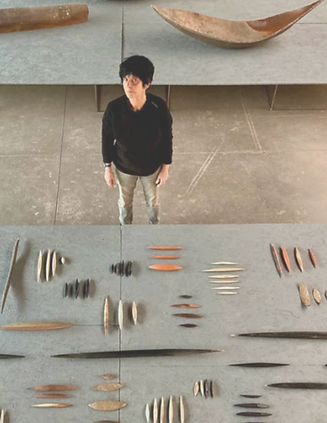
Anne Deleporte is a French-born American multimedia artist with a lifelong fascination with the phenomenon of disappearance. True to her signature practice of concealing in order to reveal, her videos, paintings, and photographs explore themes of identity and enigma. Her murals and large-scale video installations have been exhibited at Topographie de l’Art, Paris (2021); the 8th Floor/Rubin Foundation, New York, and FRAC Corse (2019); the Flag Art Foundation, New York (2018); the Musée des Beaux-Arts d’Orléans (2016); the Maison Européenne de la Photographie, Paris (2015); the Queens Museum, New York (2014); Dallas Contemporary and Momenta Art, New York (2010); the Museo do Paço Imperial, Rio de Janeiro (2009); and Prospect.1 New Orleans (2008); she also received a commission from NYC Public Arts (2014). Deleporte has exhibited her work nationally and internationally at the New Museum of Contemporary Art, PS1 MoMA, the Santa Monica Museum of Art, the Shanghai Art Museum, the Musée de l’Élysée (Lausanne), the Tang Museum, the Centre Georges Pompidou, the Musée d’Art Moderne de la Ville de Paris, and the Musée de la Chasse (Paris). In 2013, she received a grant from the Peter S. Reed Foundation. She is currently holding a solo exhibition at the Sorbonne Artgallery, open throughout December. She lives in New York and Paris.
Patrick Caron + Catherine Veglio
November 26th, 2025
Fictional Narrative - Scientific Discourse
A Dialogue on Our Food and Migration Futures
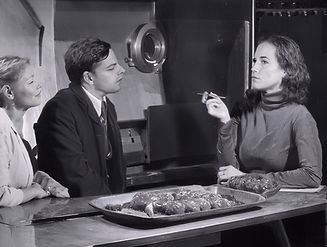
In her novel Des vies sans refuge (Sérendip’Éditions, 2024), Catherine Véglio shares with the reader the fate of migrants trapped by the machinations of a multinational corporation in a world disrupted by climate and food crises. For Patrick Caron, author of the preface, this speculative narrative, in which reality and fiction intertwine, is “an allegory of the current world projecting itself into the future, in the manner of Soylent Green,” the Richard Fleischer film.What does the use of imagination, of fictional writing, bring to the table compared to the productions of academic research? What can emerge from the encounter between science and literature? In an era of radical uncertainty, what can they say together about issues that permeate our societies, in this case, food security and the migrant experience? Could their dialogue allow for a more concrete projection of these challenges, or even an anticipation of long-term disruptions?
Patrick Caron is co-president of Agropolis International, Vice-President of the University of Montpellier for International Relations, International Director of the "Montpellier University of Excellence" (MUSE) initiative, and Director of the Montpellier Advanced Knowledge Institute on Transitions (MAK'IT). He chaired the High-Level Panel of Experts of the United Nations Committee on World Food Security (CFS) from 2015 to 2019. A researcher at CIRAD (French Agricultural Research Centre for International Development) since 1988, he also holds a doctorate in veterinary medicine, a doctorate and a habilitation to supervise research in geography, and is an alumnus of the IHEST (Institute for Advanced Studies in Science and Technology), class of 2012-2013 (Léonard de Vinci cohort). He is also the IHEST Occitanie delegate.
Catherine Véglio-Boileau is an editorial consultant and author. She was in charge of the IHEST's regional activities and responsible for the programming of the institute's national training program. She worked for nearly twenty years on European issues for the agricultural press, the daily newspaper La Tribune, and then for the think tank Confrontations Europe and the Maison de l’Europe in Paris. A graduate of Sciences Po Paris and with a law degree, she began her career in regional journalism and contributed to various national business publications. Des vies sans refuge (Lives Without Refuge) is her second novel, following La fête carnivore (The Carnivorous Feast) (Lemieux Éditeur, 2017).

Fabrice Hyber
October 22nd, 2025
A prolific artist, Fabrice Hyber has gradually built a body of work comprising paintings, charcoal drawings, collages, videos, and more. The entire oeuvre of Fabrice Hyber - which emerged in the mid-1980s - is constructed upon principles of echoes, drift, and scaffolding. Each work refuses to stand alone; instead, it serves as an intermediate, evolving stage in a "work in progress" conceived as a gigantic rhizome. Its connection points arise from a desire to forge links while simultaneously representing the proliferation of thought - an ars combinatoria.
Fabrice Hyber - who defines himself as a "quantum artist" - imbues his artistic activity and thought with constant themes of mutation and transformation. With a background in science prior to attending the École des Beaux-Arts in Nantes, the artist envisions his work as a vast rhizome that expands through a system of echoes. While his practice is invariably rooted in drawing and painting, he embraces all modes of expression, constantly circulating his work across different media: "The materiality of the work matters little; what counts is its capacity to trigger behaviors." His canvases feature cellular forms, trees with myriad branches, hybrid creatures, and arrows suggesting infinite recycling. Fascinated by viral dynamics, Hyber anticipated our networked communication era as early as the 1980s; for the turn of the millennium, he was commissioned to work on the Arc de Triomphe, where he launched the site "inconnu.net" (The Encyclopedia of the Unknown), declaring: "Each of your questions will lead to another. This branching structure will move us all in the same direction: toward the unknown." Interferences, interactions, and influences on behavior lie at the heart of his artistic approach. His fluid, multifaceted approach is constantly enriched by a dialogue with diverse disciplines - ranging from physics to neuroscience, astronomy to phytotherapy - thereby inviting the viewer-participant to engage with a much broader undertaking. Whether it is L’Hybermarché at the Musée d’Art Moderne de Paris; Eau d’or, Eau dort, ODOR - a television studio project that earned him the Golden Lion at the 1997 Venice Biennale; or the Chaosgraphie created for Vivaldi’s The Four Seasons in collaboration with Angelin Preljocaj - Hyber brings multiple dimensions into play in every project. Never limiting himself to a fixed artistic vocabulary, he explores a vast array of expressive forms and media. Fabrice Hyber will be joining us to discuss, among other things, his latest major ongoing project.

Gaelle Periot-Bled
October 15th, 2025
Gaëlle Périot-Bled is a lecturer and researcher in the philosophy of art and aesthetics at Sorbonne University. Her research focuses on the performing arts and the transmission of ephemeral works in the 20th and 21st centuries. She co-edited the anthology Répéter, refaire, reprendre. Enjeux artistiques et esthétiques (PUR, 2025) with Marianne Massin and is the author of the essay Éclats de l’éphémère, Futurisme et Dada à l’épreuve du temps agonal (1909-2009), published by Mimésis in 2025.
"Works in Fragments: Reflections on the Transmission of Two Avant-Garde Movements"
Ephemeral works, such as theatrical performances, are uniquely difficult to exhibit in museums, a fact that compromises their transmission as artworks. The case of Futurist and Dada performances is particularly interesting to study, as exhibitions of these early 20th-century avant-garde movements often cause their performative dimension to recede in favor of highlighting visual artworks (drawings, paintings, sculptures, etc.). Max Ernst’s reaction to the 1958 Dada exhibition in Düsseldorf illustrates this difficulty: "A Dada exhibition. Another one! But why is everyone so intent on turning Dada into a museum object? Dada was a bomb. Can one imagine someone, nearly half a century after a bomb has exploded, setting out to gather its fragments, glue them back together, and put them on display?" This lecture aims to examine the status of these fragments - the objects, texts, and images directly linked to an explosive artistic activity: are they merely dead things? Do they possess the power to convey the brilliance of a performance piece?

Veronica Mecchia
October 1st, 2025
Born in Paris to Italian parents, Veronica Mecchia grew up in Milan, where she trained in both art history and photography under Giuliana Traverso at the "Il Diaframma" gallery. In 2003, she returned to Paris to continue her art history studies before dedicating herself entirely to photography.
Her artistic lineage - rooted in her time as a student of photographer Arno Rafael Minkkinen in Italy (1997–1998), whom she regards as her mentor - manifests as a compelling drive to maintain an organic connection with nature.
Her black-and-white photography offers a personal exploration of the relationship between humanity and the environment. Through bold artistic choices - including the use of film, self-portraiture, monochrome imagery, and nudity - she conveys her state of mind and reveals a unique identity that resonates on a universal level.
Poetically embracing the ephemeral - as if captivated by the beauty of the things or places that move her - Veronica Mecchia invites us through her images to pause time in gentle contemplation. She leaves us with light hearts and a desire, much like her own, to inhabit the world poetically.
Her work has been featured in numerous solo and group exhibitions, and her photographs and artist's books are held in private collections across Italy, France, Belgium, Germany, Greece, the United States, Switzerland, and Japan.
Her artist's book Fotografie (Paris, May 2016) and two of her photographs have been acquired by the Bibliothèque Kandinsky at the Centre Pompidou (Paris) for the "anti-Aufklärung 2019" collection.

Julien Creuzet
March 12th, 2025
Julien Creuzet (born in 1986 in Le Blanc-Mesnil) is a visual artist, video artist, performer, and poet. Through environments composed of heterogeneous assemblages, he explores diverse cultural legacies by forging connections between imagined worlds from afar, the social realities of the here and now, and forgotten minority histories. Blending different temporalities and geographies - and favoring anachronism and collision over the simplicity of established narratives - Creuzet brings together the realms of the organic and the technological, history and myth, the poetic and the political. He unfolds the disparate stories of hybrid creatures and marshlands - spaces reclaimed yet disrupted by the drives for power and expansion characteristic of imperious civilizations.
Julien Creuzet has held numerous solo exhibitions, including recent shows at the VR Arles Festival (as part of an off-site Palais de Tokyo exhibition during the Rencontres d'Arles, 2018), the Fondation d’Entreprise Ricard and Bétonsalon - Centre for Art and Research (Paris, 2018), the NaMiMa Gallery at the École nationale supérieure d’art et de design de Nancy (2016), Frac Basse-Normandie (Caen, 2015), Camden Arts Centre (London), Document (Chicago), and CAN Centre d’art Neuchâtel. Group exhibitions include: Manifesta 13 (Marseille), Wiels Contemporary Art Center (Brussels), Museum für Moderne Kunst (Frankfurt), Kampala Art Biennale (Uganda), Dak’Art (Biennale of Contemporary African Art), Gwangju Biennale (Korea), Rencontres de Bamako Biennale (Mali), Lafayette Anticipations, Lyon Biennale, and the Centre Pompidou. Julien Creuzet represented France at the 60th Venice Biennale in 2024.

Hervé Fischer
February 12th, 2025
Hervé Fischer presents a lecture on his artistic journey, focusing in particular on a premise he formulated in the early 1970s - one that has evolved throughout his artistic and intellectual career: "The arts always come first." To launch this year of text-based festivities, it was essential to invite this artist-author to speak; by steadfastly pursuing his sociological, philosophical, and visual inquiries, he has built a body of work that stands apart from trends yet resonates deeply with the times - reflecting a sensitive mindset dedicated to a shared ideal: authenticity. An artist, sociologist, thinker, and researcher, Hervé Fischer pioneered the concept of "sociological art" in the 1970s, during the era of the avant-gardes. He developed a critical examination of the relationship between art and society, creating his work outside established institutions - in the streets, in the countryside, and now on social media - while focusing on digital practices and the new behaviors they engender.
Read also on ArtsHebdoMédias > Hervé Fischer’s Mythanalysis of Color (2023), The NFT Mirage (2023), Conversation with Hervé Fischer (2022), Hervé Fischer’s Thinking Hand (2021), Send in the Colors! (2020), Hervé Fischer’s Art in Reflection (2017).
Recent publications > Mythanalyse de la couleur, Gallimard, Bibliothèque des sciences humaines, 2023, 432 pp., €35. Les couleurs de l’Occident. De la Préhistoire au XXIe siècle, Gallimard, Bibliothèque illustrée des histoires, 2019, 512 pp., €35. Hervé Fischer recently edited two special features on art for the journal Ligeia: Art and Mythanalysis (January-June 2024, €25) and Art and Future (January-June 2023, €25).

Alberto Sorbelli
February 5th, 2025
On June 6, 2023, artist Alberto Sorbelli auctioned off a "word" at Drouot. The successful bidder became its custodian. Following a meticulously prepared legal protocol and in the presence of two notaries, Sorbelli whispered the word into the buyer's ear. The work is titled Je veux glisser une œuvre à l’intérieur d’un individu. In this talk, the artist reflects on his career and shares the catalogue-book that emerged from this recent initiative - a project in which twenty-five authors offer their interpretations of this radical and deeply original work.
Born in Rome in 1964, Alberto Sorbelli is an artist, stage director, actor, and draftsman. He lives and works between Paris, Rome, and New York. While still a student at the École des Beaux-Arts in Paris - questioning the nature of artistic production and its reception - he adopted the persona of a secretary to "Alberto Sorbelli." In this role, he held one-on-one meetings with the public, aiming to generate interest in the work of an artist who did not yet exist and had created nothing. Discovering a knack for these tailored encounters, he took his approach a step further by appearing in galleries and museums dressed as a prostitute, handing out business cards to anyone willing to accept them. By disrupting the conventions that typically govern how art is perceived in an exhibition setting, he provoked both personal and institutional hostility; this backlash led him to abandon the "hooker" persona and instead stage reenactments of the assaults he had endured. Alongside the development of this trilogy (the secretary, the hooker, and the assault victim), Alberto Sorbelli devises other models and fields of action, turning art into a service and the artist into a manager of situations that - were they not presented within an artistic context - would appear to have no connection to art whatsoever.

ORLAN
January 29th, 2025
ORLAN - whose name is always written in capital letters—is a contemporary artist of international renown. While often associated with her highly publicized performance art, she is an artist who refuses to be bound by any single material, artistic practice, mode of expression, technique, or technology - whether traditional or cutting-edge. ORLAN seeks to address issues of significance to our times by examining societal phenomena with a critical eye. She explores the status of the body - particularly the female body - questioning the traditional, political, social, and religious pressures inscribed upon it. A committed feminist, she fights - both in her life and her work - to shatter the barriers separating genders, sexes, and artistic disciplines. A pioneering and socially engaged artist, ORLAN is leaving her mark on art history while contributing to the emancipation and shaping of the contemporary world.
The talk will be followed by a screening of one of her works and a book signing, offering an opportunity to interact with the artist. (Centre Panthéon, 8:15 PM – 9:30 PM). Strip-tease. Tout sur ma vie, tout sur mon art, Témoins de l’art collection, Gallimard, 2024.

Michel Paysant
December 4th, 2024
The work of visual artist Michel Paysant stems from the many bridges he builds, driven by his ability to combine the most innovative specializations with the most traditional ones. Spanning art, ancestral craftsmanship, and cutting-edge technology, his career has been marked by encounters that have consistently propelled him further in creating an art form that is "useful yet detached from utility."
A transdisciplinary visual artist, Michel Paysant has a particular interest in collaborative and cooperative artistic practices. For years, he has created installations that bridge art, craftsmanship, science, engineering, and advanced technologies (such as the Inventariums and Nusquam series). Passionate about both classical and experimental drawing, he develops numerous research projects with scientific teams - such as DALY (drawing with the eyes, in cognitive science), OnLAB (nanotechnology), and Digital Calligraphy (robotics) - as well as projects exploring traditional techniques (glasswork in PTPM/Pensée Technique, Pensée Magique; weaving in Basket Case; and ceramics in La Céramique Comme Expérience).
His installations are open and poetic, aiming to foster a dialogue between the art world and the surrounding spheres by devising techno-aesthetic systems. For thirty years, Michel Paysant has exhibited in museums (Centre Pompidou, Musée du Louvre, Musée d’Art Moderne de la Ville de Paris, Musée des Arts Décoratifs de Paris, Centraal Museum in Utrecht, Zentrum Paul Klee in Bern, MUDAM in Luxembourg, Galleria d’Arte Moderna in Bologna, Museo Nacional de Artes Visuales in Montevideo, National Gallery of Zimbabwe in Harare, MACBA in Buenos Aires, Nouveau Musée National de Monaco, National Museum in Riyadh, UCCA in Beijing…), art centers (Brooklyn Bridge Space/Creative Time in New York, Mercer Union in Toronto, David Roberts Art Foundation in London, Bétonsalon in Paris, Synagogue de Delme, FRAC Picardie…), and galleries.

Vik Muniz
November 27th, 2024
Vik Muniz is a Brazilian artist based in Brooklyn, New York. He began his career as a sculptor in the late 1980s. He gained global recognition in 1997 with his Pictures of Chocolate series and again in 2006 with his Pictures of Junk series.
In 2010, the documentary film Waste Land, directed by Lucy Walker, followed Vik Muniz over three years as he created a unique art project in the heart of the world's largest landfill, Jardim Gramacho, located on the outskirts of Rio de Janeiro. The artist set up near the landfill and launched a participatory project in which waste pickers gathered and arranged the refuse. One of his installations was exhibited at the Museum of Modern Art in Rio de Janeiro, alongside the Rio+20 climate summit.
A key aspect of Vik Muniz’s art is his ability to transform any material into an artistic medium. He uses photography to capture the images he creates from an immense variety of materials: soil, sugar, excrement, ketchup, wire, linen thread, rope, artificial blood, colored tokens, modeling clay, and more.
He is represented in Paris by the Xippas Gallery.

Bénédicte Ramade
November 13th, 2024
Drawing on several curatorial projects - including an exhibition by land artist Richard Long at Les Tanneries in Amilly - Bénédicte Ramade will contextualize her empirical methodology of ecocritical re-examination. She will discuss the potential for reinterpreting historical works through this method, specifically as applied to Nicolas Party’s 2021 solo exhibition at the Montreal Museum of Fine Arts. At a time when museums must incorporate decolonial and feminist perspectives, how can environmental history be integrated into art history? Furthermore, how can one avoid the pitfalls of anachronism and anecdote - common issues in recent theoretical work in this field?
Drawing on her experience as both a researcher and a practitioner (in curating and art criticism), Bénédicte Ramade will outline the issues surrounding the "Anthropocenization" of knowledge and artistic practices.
Bénédicte Ramade is an art historian specializing in artistic practices linked to environmental and ecological issues since the late 1990s. Her book, Vers un art anthropocène... Her book L’art écologique américain pour prototype, published in 2022 by Les Presses du réel, updated the doctoral research she conducted in aesthetics and art history at the Université Paris 1 Panthéon-Sorbonne, which focused on rehabilitating this movement that emerged in the 1960s. The book was a finalist for the 2023 Pierre Daix Prize for art history books.
She serves as a scientific advisor for the Grantham Foundation for Art and the Environment (Saint-Edmond-de-Grantham), the Pointe-à-Callière Museum, and the Centre Pompidou; with the latter - and in partnership with Figura-UQAM - she developed the content for a MOOC on art and ecology, launched in 2022, which has garnered over 25,000 registrations to date. At the invitation of the Musée d’art contemporain de Montréal, she curated the program for the 16th Max and Iris Stern International Symposium, held on April 12 and 13, 2024, under the theme "More-than-Human, More-than-Nature: Beyond the Living" (featuring Julie Creen, Emanuele Coccia, Giovanni Aloi, and T.J. Demos).

Vincent Lavoie
November 6th, 2024
As co-curator of the exhibition *Fait divers : une hypothèse en 26 lettres, 5 hypothèses et aucune réponse (opening at MAC VAL on November 15, 2024), Vincent Lavoie will discuss this project, which focuses on contemporary artistic representations of the fait divers - the human-interest story or minor news item.
Vincent Lavoie is a photography historian and full professor in the Department of Art History at the Université du Québec à Montréal. His publications include Photojournalismes. Revoir les canons de l’image de presse (Paris, Hazan, 2010), La preuve par l’image (Quebec City, Presses de l’Université du Québec, 2017), L’Affaire Capa. Le procès d’une icône (Paris, Éditions Textuel, 2017) - which was translated into Italian by Johan & Levi (Monza, 2019) - and Trop mignon ! Mythologies du cute (Paris, PUF, 2020; Paris, Humensis, 2022). In collaboration with Thierry Gervais, he published Facing Black Star (Toronto/Cambridge, RIC Books/The MIT Press, 2023), a collective work examining research methodologies applied to press photography archives. He is the principal investigator for the research project "Visualités du bien-être animal" (SSHRC), which is dedicated to the study of charitable and recreational representations of animals.

Manuela Oneto
October 16th, 2024
Manuela Oneto first studied art history at the University of Genoa (Italy). She published TecnoMutazioni, a work on third-millennium post-futurism. She later earned a doctorate in the technology of the arts from the University of Paris VIII with a thesis on cyberpunk. Passionate about contemporary art and underground culture, she organizes exhibitions in both France and Italy.
Cyberpunk is best known as a literary genre - a branch of science fiction featuring cyborgs and droids in a post-atomic future. Yet, cyberpunk is also a genuine artistic movement. In the early 1980s, artist collectives adopted a neo-tribal and cyber-primitive lifestyle; groups such as the Mutoid Waste Company, La Fura dels Baus, and Survival Research Laboratories showcased their cyberpunk machines in apocalyptic performances, sparking a true artistic revolution.

Anna Szyjkowska-Piotrowska
October 9th 2024
Can we find a particular idiom of the avant-gardes in one country or another? If it is possible, it would be in relation to what I would call a gesture. A gesture which marks meaning, a gesture which performs, which sets things in motion, which makes things move forward. Starting with anti-modern modernists like Witkacy or Schulz, passing through what we could call a classic of the Polish avant-gardes (Kobro, Strzemiński, a.r. group and many others) we will also discover obscure spaces in the history of art the gestures of women artists (Abakanowicz, Tapta) who weaved another history of the avant-gardes into the genre of textile art.
Anna Szyjkowska-Piotrowska is a philosopher, author and conceptual artist with an interdisciplinary approach (Master in Philosophy and Applied Linguistics, PhD in Philosophy of Art, held at the University of Warsaw, Poland; Accreditation to direct research in philosophy, held at the Maria Curie-Sklodowska University, in Lublin, Poland.
Associate professor of art theory at the Academy of Fine Arts in Warsaw and at the Frédéric Chopin University in Warsaw. Since 2022, she has also been an associated researcher at the University of Paris 1 Panthéon Sorbonne, at the ACTE Institute, in the Aesthetics Axis and critical theories of culture, and a member of MODERNITAS/Interdisciplinary research center on the avant-gardes. She is the author of Po-twarz. Przekraczanie widzialności w sztuce i filozofii, słowo/obraz terytoria, 2015, Dyrygując falom. Myślenie w awangardach wizualno-muzycznych, słowo/obraz terytoria 2019 and other books and articles on art and philosophy, among others The Elusiveness of the Face. Aesthetic enchantment and ethical gaze, with Gwenola Druel and Leszek Brogowski, PUR 2024.

Eva Jospin
December 13th 2023
A graduate of the École Nationale Supérieure des Beaux-Arts in Paris, Eva Jospin (b. 1975, Paris) has spent the last fifteen years creating forest and architectural landscapes across various media. Winner of the Académie des Beaux-Arts Prize in 2015 and a resident at the Villa Medici in Rome in 2017, she has been the subject of numerous major international exhibitions, notably at the Palais de Tokyo (Inside, 2014), the Palazzo dei Diamanti in Ferrara (2018), the Museum Pfalzgalerie in Kaiserslautern (2019), the Hayward Gallery (2020), and the Het Noordbrabants Museum in Den Bosch (Paper Tales, 2021). Most recently, she presented a carte blanche exhibition within the permanent collections of the Musée de la Chasse et de la Nature in Paris (Galleria, 2021).
The artist has also unveiled several monumental, immersive installations created for specific commissions, such as Panorama (2016) in the center of the Louvre’s Cour Carrée and Cénotaphe (2020) at the Abbey of Montmajour. She designed an extraordinary set of embroidered panels - Chambre de Soie - for the Dior Haute Couture show in 2021, and subsequently created the monumental set design for the Dior Spring-Summer 2023 ready-to-wear show (Nymphées, 2022).
Jospin has also created permanent works, including the Folie installation at the Domaine de Chaumont-sur-Loire (inaugurated in 2015), La Traversée at Beaupassage in Paris (2018), and Le Passage in Nantes (2019). In 2022, she unveiled Microclima, a new permanent installation conceived as a winter garden within the Max Mara store at Piazza del Liberty in Milan. In 2023, around twenty of the artist’s works were presented at various contemporary art fairs around the world as part of a carte blanche commission from Maison Ruinart. This series of works is linked to Eva Jospin’s solo exhibition at the Fondation Thalie in Brussels in the spring of 2023 (Panorama), as well as the exhibition that opened in the summer of 2023 at the Palais des Papes in Avignon (Palazzo).

Léonard Pongo
November 29th 2023
Born in Belgium in 1988, Léonard Pongo lives and works between Brussels, Belgium, and Kinshasa, Democratic Republic of the Congo.
A visual artist and photographer, Pongo views photography as a tool for reclaiming his Congolese heritage; through projects like Uncanny, he documents daily life in the Congo’s major cities - work that has earned him several international awards.
He is currently focused on exploring the diversity of the Congolese landscape, offering an allegorical vision of the country steeped in a sense of magical beauty and mystical power. This long-term endeavor is unfolding through a series titled Primordial Earth.
Pongo’s work has been published worldwide and featured in numerous exhibitions, notably IncarNations at the Bozar Centre for Fine Arts in Brussels (2019) - curated by Kendell Geers and Sindika Dokolo - and the 3rd Beijing Photo Biennial at the CAFA Art Museum.
In 2016, he was named one of PDN’s "30 Emerging Photographers to Watch." He is a recipient of the 2017 Visura Grant and the 2018 Getty Reportage Grant, and participated in the 2018 Joop Swart Masterclass. Primordial Earth, his latest project, was presented at the Lubumbashi Biennale and the Rencontres de Bamako, where it won the "OIF Prize." In 2021, he held a solo exhibition at Bozar Brussels. In 2022, he exhibited at the 31 PROJECT gallery as part of the show Je suis moi-même le soleil (I Am the Sun Itself), curated by Liz Gomis. That same year, Mu.Zee in Ostend, Belgium, hosted a solo exhibition of his work. He was also a participant in the Black Rock residency in Dakar, Senegal, founded by Kehinde Wiley. In 2023, he published his first monograph, The Uncanny, with Gost Books and participated in the exhibition A World in Common: Contemporary African Photography at Tate Modern in London.

Joël Hubaut
November 22nd, 2023
Born in Amiens in 1947, Joël Hubaut has developed a hybrid body of work - fictional and interdisciplinary - characterized by a multiplicity of media and a variety of actions. He began his work in the late 1960s, inspired by the writings of W. S. Burroughs, the music of Erik Satie, Actionism, Pop art, and the theoretical ideas of the B.M.P.T. group. Although he primarily creates sculptures based on the détournement of objects and drawings involving "contamination," he is paradoxically best known for his poetry and his distinctly rock-and-roll-style performances and installations. Since 1970, his work has been defined by the concepts of the dérive épidémik and the "mix."
He founded the alternative space Nouveau Mixage in Caen (active from 1978 to 1985), established the C.R.E.M. publishing house in 1987 and the audio magazine Fractal Musik, and for several years organized and hosted the Hiatus gatherings at Frac Basse-Normandie. Joël Hubaut is the creator of numerous experimental actions under the banner of Épidémik (documented in Re-Mix épidémik - Esthétique de la dispersion, published by Les presses du réel).
Joël Hubaut is an artist who defies easy classification. By placing the epidemic and contamination - acts that serve as premonitions - at the heart of his reflections on art and society, he employs parody and mockery in ways that can take on a truly tragic dimension.
"Epidemic in every sense and everywhere, Joël Hubaut is an eccentric figure and force within the French contemporary art landscape: boundary-pushing, unconventional, and operating at the intersection of various disciplines (draftsman, painter, video artist, singer, writer, event organizer, and teacher). A living body of work in a state of constant gestation, Hubaut has evolved into an enterprise of collective projects, acting as a utopian rebel who refuses all forms of submission." A boisterous, burlesque shouter - with a touch of carnival, a dash of Guignol and Pinocchio - earthy and full of life.

Pascale Le Thorel
November 8th, 2023
Pascale Le Thorel is an art critic, publisher, and exhibition curator. She works primarily in the fields of 20th-century and contemporary art. She has directed Beaux-Arts de Paris Éditions since 2000, overseeing the publication of over 400 titles. Her recent exhibitions include Fadia Ahmad: Photographs (Beirut City Museum and Jordan National Gallery of Fine Arts) and Libres. Figurations années 80 (Hélène & Édouard Leclerc Fund for Culture, Calais Museum of Fine Arts, and Cité de la Mode). She is the author of several works, notably a biography of Picasso (Buchet-Chastel, 2003); Monory (Paris-Musées, 2006); Peter Klasen et la photographie : l’investigation du réel (Actes Sud, 2010); the Dictionnaire des artistes contemporains (Larousse); the Dictionnaire des artistes modernes (Larousse); and, in 2022, L'art contemporain par les femmes (Larousse).

Maria Filmera Molder
October 18th, 2023
Maria Filomena Molder is a distinguished professor of Aesthetics at the Universidade Nova de Lisboa. She is known for her editorial works such as "Paisagens dos Confins" by Fernando Gil in 2009, and "Rue Descartes nº 68, Philosopher au Portugal Today" in 2010, as well as for her contribution as co-editor of "Morphology. Questions on Method and Language" by Peter Lang in 2013.
She has published several books on the connection between the arts, poetry and philosophy, some of which have received prestigious awards such as the Pen-Club Prize for Essay in 2000, 2012 and 2018. She also received the AICA Prize for Essay on Art in 2018 and the Jacinto Prado Coelho Prize for Essay in 2021.
In addition to her academic work, she has written for art catalogs, notably on contemporary Portuguese art, and has contributed to international journals such as Análise, Internationale Zeitschrift für Philosophie, Sub-Rosa, La Part de l'Oeil, Rue Descartes, Gratuita, Europe, Cadernos Nietzsche, Lettre International, Electra, Diaphanes and Perspective.
She is also the main manager of the FCT project, “Fragmentation and reconfiguration: the experience of the city, between art and philosophy” from 2018 to 2022.
Her approach to art appears to be deeply influenced by philosophers such as Walter Benjamin, with particular attention paid to the relationship between darkness and artistic creation.

Éric Alliez
September 27th, 2023
Éric Alliez holds a Doctorat d’État (defended in 1987 under the supervision of Gilles Deleuze) and is a Professor of Philosophy and Contemporary Art Creation at the University of Paris 8, as well as a research associate at the Centre for Research in Modern European Philosophy, Kingston University (London). He has served as a visiting professor at numerous universities and art schools abroad.
His publications include: Les Temps capitaux (preface by G. Deleuze), Paris, Cerf, 2 vols., 1991/1999; La Signature du monde, ou Qu’est-ce que la philosophie de Deleuze et Guattari ?, Paris, Cerf, 1993; De l’impossibilité de la phénoménologie. Sur la philosophie française contemporaine, Paris, Vrin, 1995; Deleuze. Philosophie virtuelle, Paris, Synthélabo, 1998; Gilles Deleuze. Une Vie philosophique (edited by), Paris, Synthélabo, 1998; The Guattari Effect (edited by É. Alliez and Andrew Goffey), London/New York, Continuum, 2011; Spheres of Action: Art and Politics (edited by Éric Alliez and Peter Osborne), London, Tate Publishing, 2013; Guerres et Capital (with Maurizio Lazzarato), Paris, Amsterdam, 2016; Capitalism: Concept, Idea, Image. Aspects of Marx’s Capital Today (edited by É. Alliez, P. Osborne, and E.-J. Russel), London, Radical Philosophy Publishing, 2019.
A series of works develops a "Critique of Aesthetics" comprising a trilogy: L’Œil-Cerveau. Nouvelles Histoires de la peinture moderne (with J.-Clet Martin), Paris, Vrin, 2007; La Pensée-Matisse. Portrait de l’artiste en hyperfauve (with J.-Claude Bonne), Paris, Le Passage, 2005; Défaire l’image. De l’art contemporain (with J.-Cl. Bonne), Dijon, Les Presses du réel, 2013.
He has just published Duchamp avec (et contre) Lacan. Essai de mutologie queer, Dijon, Les Presses du réel, September 2022.

Céline Flécheux
November 30th, 2022
From the horizon to the return: what detours, and for what kind of sojourns?
Céline Flécheux is a professor of the history and theory of contemporary art at the University of Paris 8–Saint-Denis. Her research focuses primarily on the horizon and its connections to landscape, philosophy, and the visual arts. She has published two books on this subject: L’Horizon, des traités de perspective au Land Art (PUR, 2009) and L’Horizon (Klincksieck, 2014). A co-founder of the "Les Contemporains" research program alongside Magali Nachtergael (2013–2016), she co-directs the book series of the same name for Éditions P. She writes regularly on modern and contemporary art (covering artists such as Abraham Poincheval, Anna-Eva Bergman, Robert Smithson, François Morellet, Nancy Rubins, and Chris Burden). After publishing - with Emmanuel Alloa - the first French translation of a work by German phenomenologist Gernot Böhme (Aisthétique. Pour une esthétique de l’expérience sensible, Presses du réel, 2020), she is currently preparing an issue of the journal Pistes with Céline Bonicco-Donato on the uses of the concept of "atmosphere" in the arts. Her book Revenir. Les épreuves du retour - in which she explores the ambiguities of returning, an act that is at once sweet and dreaded - is forthcoming in January 2023 from Éditions du Pommier.

Vladimir Skoda
November 23rd, 2022
Vladimír Škoda is a sculptor born in Prague in 1942 who has lived and worked in Paris since 1968. Interested in manual craftsmanship, he began training as a lathe operator and miller while attending evening drawing classes alongside his factory job. During a trip to Paris at the age of 26, he decided to move to France to restart his education - this time in the arts. Accepted into the Beaux-Arts, he studied under César and worked with wire. In the early 1970s, he discovered contemporary art. His early works were gestures of positioning vis-à-vis Nouveau Réalisme, followed by Arte Povera and Antiform. Having grown up with a keen interest in mathematics and physics, his visual vocabulary has always consisted of simple geometric forms - spirals, cubes, and polyhedra - yet since the mid-1980s, he has given pride of place to the sphere, exploring it in all its variations. Whether tiny polished steel ball bearings, large helium-filled balloons, or pendulums whose shifting reflections play out across a concave mirror, Škoda’s spheres - small or large, animated or still, solitary or innumerable - are miniature worlds. Made of polished steel, they reflect their surroundings and draw the visitor into their universe; the energy of the body, in its interaction with the material, takes center stage. The forms he employs - rooted in simple geometry - allow him to articulate a dialogue between the material’s inherent nature, his preliminary sketches, and the project itself. His early "balls," "spinning tops," and "pyramids" are the result of this process. His spheres, polyhedra, and concave or convex surfaces whether placed on the ground or against a wall - evoke a sense of weight and mass through their gravity and tangible presence, even when crafted from polished steel that reflects the surrounding space. Hovering between microcosm and macrocosm, Vladimír Škoda varies the forms and outer shells of his sculptures. The sphere has become a primary focus of his artistic inquiry, allowing him to explore the manifold relationships between the interior and exterior of the material, and between the viewer's space and that of the artwork itself. Vladimír Škoda’s work engages with the cosmos and the laws of the Universe.

Esther Shalev-Gerz
November 9th, 2022
Based in Paris, Esther Shalev-Gerz is internationally recognized for an artistic practice that examines the construction of knowledge, history, and identity. Rooted in the tradition of portraiture, her works question the very nature and practice of the genre, inviting us to consider how its qualities can contribute to contemporary debates regarding the politics of representation. Her monuments, installations, photographs, videos, and public art projects are developed through ongoing dialogue, consultation, and negotiation with the various stakeholders involved in each project. Her work represents an ongoing exploration of the potential for change across time and space, and the resulting transformations of identities, places, and histories. She acknowledges, critiques, and contributes to a vision of the role and societal value of artistic engagement. Born Esther Gilinsky in Vilnius, Lithuania, she has lived and worked in Paris since 1984. A graduate of the Bezalel Academy of Art and Design in Jerusalem, she also lived in New York from 1980 to 1981. In 1986, she co-created the Monument Against Fascism in Hamburg, a work that remains a touchstone in contemporary discourse on monuments and memory. She has conceived and executed permanent public art installations in locations including Israel, Hamburg, Stockholm, Wanås, Geneva, and Glasgow. In 2010 and 2012, major retrospectives - first at the Jeu de Paume in Paris and subsequently at the Museum of Fine Arts in Lausanne - brought together around fifteen of her installations. Her solo exhibition Space Between Time at Wasserman Projects in Detroit showcased nine of her installations between April and July 2016. In 2018, she unveiled a monumental permanent installation, The Shadow, on the campus of the University of British Columbia in Vancouver, Canada. In 2022, his sculpture King & King was installed in a private collection in Pittsburgh, United States.

Lydia Goehr
October 19th, 2022
Born in London in 1960, she is a philosopher internationally recognized for her work in aesthetics. After completing her doctoral thesis on the ontology of music at the University of Cambridge, she secured a permanent professorship at Columbia University (New York). Her work focuses on the philosophy of music and the history of aesthetic theory, seeking to understand the relational nature of norms and power dynamics alongside the structures that constrain them and regulate their practice. Much of her scholarship centers on the musical arts, exploring the complex and often adversarial relationships between the arts themselves, as well as between the arts, philosophy, and religion. She has received numerous awards for both her research and her teaching, including Getty and Guggenheim Fellowships (2012), the American Musicological Society’s H. Colin Slim Award (2009/2010), the Lenfest Distinguished Columbia Faculty Award (2005), and the Columbia Presidential Award for Outstanding Teaching. Her publications include The Imaginary Museum of Musical Works: An Essay in the Philosophy of Music (Clarendon Press, Oxford, 1992); A Quest for Voice: On Music, Politics, and the Limits of Philosophy (Clarendon Press, Oxford, 1997); Elective Affinities: Musical Essays on the History of Aesthetic Theory (Columbia University Press, 2008); and Red Sea - Red Square - Red Thread: A Philosophical Detective Story (Oxford University Press, 2021). She co-edited The Don Giovanni Moment: Essays on the Legacy of an Opera with Daniel Herwitz, and the Wiley Blackwell Companion to Arthur C. Danto with Jonathan Gilmore. Her work available in French translation includes Politique de l’autonomie musicale (Philharmonie de Paris, 2016).

Grégory Chatonsky
October 5th, 2022
Born in Paris in 1971, Grégory Chatonsky lives and works in Paris and Montreal. In 1994, he founded Incident.net - one of France’s first Net art collectives - and adopted the Web as his medium. From 2001 onwards, he began a series exploring the aesthetics of ruins and extinction as a phenomenon that is inextricably both artificial and natural, effectively returning technologies to their mineral materiality. Starting in 2008, he turned his focus to AI and the capacity of statistical induction to automate mimesis. In the context of human extinction, AI emerges as an attempt to create a preemptive monument - one destined to endure beyond our disappearance. Chatonsky has held an international research chair at the University of Paris VIII and has taught at Le Fresnoy and UQAM. He served as an artist-researcher at ENS Ulm, where he co-led a research seminar on artificial imagination with Béatrice Joyeux-Prunel, and he currently teaches at EUR Artec. A recipient of numerous international residencies and awards - including Villa Kujoyama, the 2018 Audi Talents Award, and the 2020 MAIF Prize - Chatonsky regularly participates in solo and group exhibitions in France and abroad.

Ariel Kyrou
September 21st, 2022
Journalist, writer, and essayist. He draws on science fiction, counter-culture, and contemporary art - as well as philosophy - to reflect on and help heal the world of today (and tomorrow). He is the editorial director of the Fondation Cognacq-Jay’s Laboratoire des solidarités and a member of the editorial collective of the journal Multitudes. He co-wrote the screenplay for the documentary Les Mondes de Philip K. Dick. Describing himself as a "multi-hatted agitator," his works include Google God, Big Brother n’existe pas, il est partout (2010), L’ABC Dick (2009), Ceci n'est pas un blasphème (co-authored with artist Mounir Fatmi, 2015), and Dans les imaginaires du futur (2020).

Bernard Moninot
April 6th, 2022
« Bernard Moninot’s work defies classification into any of the major expressive categories. Although it employs pigment, it does not fall under the heading of painting; while it unfolds in space, it is not perceived as sculpture; and, finally, it does not truly fit the definition of an installation. It is most accurate to describe it as a form of drawing - albeit an expanded drawing (in the sense that Novalis spoke of "expanded poetry") - that manifests as spatial objects created upon or through entirely original materials for tracing and inscription: glass, wind, metal, lampblack, and percussion. It is a form of drawing that even engages with photography through its relationship to time (snapshots, exposure times). The first part of this text will address this singularity by describing one or more recent works and the sites where they are produced - the studio, or outdoor settings such as a garden (in the case of the wind drawings). Next, the discussion will turn to a kind of hidden tradition: that of speculative artists whose work is conceived as fundamental research grounded in the spatiotemporal realities of their era. While this artistic model is well-established in the Quattrocento and has recurred throughout history, it is somewhat neglected today - even though the radical shifts in our concepts of space and uses of time call for a fresh exploration. Bernard Moninot has dedicated himself to this very task. Meditative and patient, his approach is far from abstract; on the contrary, it touches upon the very elements that underpin our existence: our perception of space and our position in time. Light, shadows, reflections, projections, echoes, waves, and propagation - the artist engages in a genuine poetics of listening. His works can be divided into two categories: instruments, on the one hand, and recordings or tracings, on the other. "But to approach these various works - as well as the protocols governing their execution - the text will trace the artist’s trajectory, from the early days (the Vitrines) to the present (such as La mémoire du vent and Fil d’alerte). It will do so not only by examining the works themselves but also by attempting, in each instance, to revisit the process of their creation. » - Jean Christophe Bailly.

Esmeralda Da Costa
February 23rd 2022
A French-Portuguese artist born in 1982, Esmeralda Da Costa studied sociology before enrolling at Villa Arson in Nice, graduating with jury honors in 2011. She lives and works in Paris.
Challenging the limits of her own body, Da Costa initially developed a body of work - using video installations - that explores the intimate self, lineage, and memory. Her immersive works gradually reveal the "other." She creates sound installations that blend the human and the technological to examine profound global shifts and the evolution of human relationships. She films and photographs the unleashed forces of nature, then composes and assembles images that mirror a threatened natural world. Sensitive to media manipulation of information, she reinterprets print media visuals through linocut techniques. In her latest creation, she appropriates the history of a French heritage masterpiece - the Apocalypse Tapestry of Angers - offering a contemporary interpretation shaped by the social upheavals of our time. Winner of the 2018 OplinePrize, she has participated in numerous video art festivals and group exhibitions (Instants Vidéo Numériques et Poétiques - Marseille, 2021; Bons baisers de Nice, Galerie Espace à Vendre – Nice; Les arts éphémères, 12th edition, Parc de Maison Blanche – Marseille; L’écho du silence, Espace 16K - Le Kremlin-Bicêtre, 2020; While I’m Waiting, Code & Canvas – San Francisco, USA, 2019; FIAV, Institut Français de Casablanca - Morocco, 2019; Videoformes, Salle Gaillard - Clermont-Ferrand, 2018; Instants Vidéo Numériques et Poétiques - Marseille, 2017; Video Art Festival – Bibliotheca Alexandrina, 2017; Official Selection Arte Video Night #7, MEP - Paris, 2015, etc.). Her work has also been the subject of several solo exhibitions, notably Apokálupsis at Repaire Urbain in Angers (2021); Altera(c)tions at Anis Gras in Arcueil (2019); La Terre-Mère / A Terra Mae at Centro Cultural Adriano Moreira in Bragança, Portugal (2017); and MATCH at Galerie Incognito in Paris (2015)...

Richard Conte
February 16th, 2022
Richard Conte is a visual artist working in the fields of painting, performance art, and cinema. He has consistently combined artistic practice, research, and teaching throughout his career. He is currently Professor Emeritus at the Sorbonne School of Arts (Université Paris 1), having previously directed CERAP (EA 2479) from 1998 to 2012 and the ACTE Institute (CNRS UMR 8218) from 2012 to 2017. He also served as an advisor on creative projects for the CNAM and the Musée des Arts et Métiers (2018-2020) and is a member of AICA. His research focuses primarily on the study of creation (poïétique) in relation to painting, philosophy, insularity, science, and sport. He now devotes himself to painting and writing.
Recent publications (selected): 2022, Les animaux malades de l’humain, exhibition catalogue, Confucius Institute of Tahiti (text by Richard Leydier); Danse avec les bêtes (with poet Serge Pey), Tarabuste Editions - 2020, “The Zidane film,” in Post-cinéma, Dominique Chateau and José Moure (eds.), Amsterdam University Press; “Se rincer l’œil, une divagation poïétique,” Recherches en Esthétique No. 26, “Le (déplaisir).” - 2019: Migration & Memory: Arts and Cinemas of the Chinese Diaspora, MSH du Pacifique-sud (UPF and CNRS) - Editor. - 2018: Entre amis (with Michel Gouéry and Gilles Tiberghien), exhibition catalogue, Galerie Michel Journiac, Paris.
Recent films about RC: 2018, Le passeur, by Christian Lallier; 2021, Tant qu’il y aura du miel, by Axel Clévenot.

Jean Faucheur
December 1st, 2021
Jean Faucheur is a French painter, sculptor, photographer, and video artist born in Neuilly-sur-Seine in 1956; he currently lives and works in Paris.
After graduating from the ENSAD (École Nationale des Arts Décoratifs) in 1979, he set up his studio in Versailles. Feeling constrained there, he decided to display his work on the street, becoming a pioneer of new forms of urban intervention (known in 1985 as "Médias Peintres" or "Media Painters").
Starting in 1983, he created large-format paintings on kraft paper, which he then illegally pasted onto 4x3-meter billboards across Paris. Over the next two years, he traveled to New York at the invitation of Tony Shafrazi - a renowned gallerist who was exhibiting artists like Keith Haring, Basquiat, and Futura 2000 at the time. He also visited Tokyo and co-founded Les Frères Ripoulin, a collective of young painters who, admiring his billboard work, asked him to teach them his technique. A multidisciplinary artist, he organized unsanctioned exhibitions in the Paris metro and at Le Palace, co-founded the Jean-Marc Patras gallery, and began showing his work at Agnès b.’s gallery in 1984.
From 1986 onwards, he stepped away from the street art scene to focus on sculpture, painting, and photography. In 2001, meeting Thom Thom - an artist who creates art by cutting into advertising posters - prompted him to reconnect with the urban art scene. This led to a series of exhibitions titled "Implosion / Explosion" and "Une Nuit," which brought together nearly 150 urban artists between 2002 and 2005. In March 2003, the association Le M.U.R. (Modulable Urbain Réactif) was founded by Jean Faucheur at the corner of Rue Oberkampf and Rue Saint-Maur in Paris. In 2007, urban artists began creating works on this 3x8-meter billboard - a practice that has continued every two weeks for nearly 15 years. Alongside this, he has participated in numerous collaborative artistic projects (such as the Akrylonumerik video-painting performances, the D-Rush collective, and Musée Imaginaire). In the summer of 2015, he served as artistic director for "Les Murs de L2" in Marseille, and in 2018, for "À l'échelle de la ville" in Paris (under the auspices of the Ministry of Culture). Since then, he has served as president of the Fédération de l’Art Urbain (Urban Art Federation). His strong inclination for sharing and breaking with convention undeniably establishes Jean Faucheur as a pioneer and a discoverer of talent.

Félicie d'Estienne d'Orves
November 17th, 2021
Félicie d’Estienne d’Orves is a visual artist who works with light as her primary medium. Her installations and performances draw upon a phenomenological understanding of reality and question how our perception is conditioned. In her work, light serves as both the tool and the subject. She explores the definition of spatial boundaries - both physical and cosmological - through light and its speed.
Winner of the 2019 Vasarely Foundation Prize and a visiting artist-professor at Le Fresnoy (Studio National des Arts Contemporains), she saw her installation "Eclipse" enter the Beep Collection Electronic Art (Spain) and the Iberdrola Foundation (Spain) collections that same year. Since 2020, she has been commissioned to create permanent works, such as for the Grand Paris Express (under the "Tandem" program in collaboration with the Dietmar Feichtinger agency) and for the city of Leuven (Belgium) as part of the "Nouveaux commanditaires" (New Patrons) initiative.
Her work has been exhibited at the Centre Pompidou, Nuit Blanche, Le Centquatre (104), and Sorbonne Artgallery (Paris); Le Fresnoy Scène Nationale (Tourcoing); the Vasarely Foundation (Aix-en-Provence); Maubuisson Abbey (Saint-Ouen-l’Aumône); Le Havre’s 500th Anniversary celebrations (Le Havre); State Studio (Berlin); Watermans Arts Center (London); New Art Space / Sonic Acts (Amsterdam); TBA Teatro do Bairro Alto (Lisbon); Ars Electronica (Linz); Elektra Festival (Montreal); Day For Night (Houston); OCAT (Shanghai); and the Aram Art Museum (Goyang, South Korea), among others.

Decebal Scriba
November 8th, 2021
Decebal Scriba was born in Romania in 1944 and arrived in France in 1990.
Through a coherent body of work created using diverse media - photography, installation, performance, and video art - the artist engages with conceptual and performance art, issues of formal and textual language, spatial representation, and the symbolism of gestures and forms. The sign is omnipresent in his work, referencing written, bodily, mathematical, and even ritualistic languages. It thus serves as a vehicle for both philosophical and political reflection, questioning the relationship with others and with art.
Having been consigned to anonymity due to its political nature, the work he produced during the Romanian dictatorship has in recent years been rediscovered and recognized within the European art scene. At the same time, the artist continues to explore the realm of conceptual art through performance, photography, and drawing, sustaining philosophical reflections - imbued with spirituality - on the relationship with the world and existence.

Thomas Hirschorn
October 14th, 2021
Thomas Hirschhorn is a Swiss artist born in Bern on May 16, 1957. Since the late 1980s, he has focused on creating handmade, precarious sculptures. He constructs them using everyday materials such as waste paper, aluminum foil, and cardboard. His sculptures often serve as "monuments" to people he admires. They sometimes require the participation of the local community, reflecting Hirschhorn's refusal to be an artist confined to high-society circles. His work engages with the questions, contradictions, and scandals that trouble contemporary society in the age of globalization. The artist advocates for greater justice and equality. "Energy yes, quality no," declares the artist - creator of installations that appear chaotic, improvised, and "poor," yet are in reality highly structured. In 2000, upon awarding him the Marcel Duchamp Prize, the jury noted that "the laureate demonstrates true maturity and a strong sense of artistic responsibility, and that his work displays remarkable originality and inventiveness." Hirschhorn's social and political concerns culminated in 2004 with the opening of the Musée Précaire Albinet in Aubervilliers - a way to "bring art into existence beyond the spaces usually dedicated to it." It was an unusual, prefabricated museum staffed by local residents, where ephemeral walls displayed 20th-century masterpieces for three months - works by Duchamp, Malevich, Mondrian, Dalí, Beuys, Warhol, Léger, and others - mostly on loan from the Centre Pompidou.

Christian Jacard
October 7th, 2021
Long fascinated by traces, imprints, fossils, and waste - anything bearing the mark of time’s passage - he began using objects to mark his canvases. Christian Jaccard uses no paintbrushes; instead, he employs insects, ropes, and paper. He also uses slow-burning objects to imprint his medium. Soon, his works were covered in black scorch marks; he even applied this signature gesture to anonymous canvases and magazines. This technique - which he defines through the concept of "supranodal art" - involves an element of chance that the artist particularly values, as it injects a playful spirit into an art world where technique often dominates. The ash staining the canvas evokes the color of the void - the state that precedes life and follows death. Over time, he liberated these ash traces from the canvas, allowing them to spread into other spaces.
An exhibition dedicated to his work was held this year at the Musée National d’Art Moderne (Centre Pompidou).