
Soudain
Anne Deleporte
December 1, 2025 to January 16, 2026
Aesthetic Modernity and Framing
Aesthetic modernity has often been associated with framing. It replaces the representation of objects with the definition of spaces. Baudelaire’s modern eye, sensitive to the fleeting, captures the sway of a garland or the clouds drifting across the sky. It places a window onto reality in order to cut out a movement. Anne Deleporte also looks at clouds, but to discern lightning within them. She follows their flashes and gathers their passages of light. The luminous phenomenon—whether coming from the sky or from the revelation of color—lies at the heart of her work.
Revealed Papers
In New York, in Queens, where old printing presses still operate, Anne Deleporte collects papers and newspapers, fascinated by the first flows that precede the appearance of typographic characters. This moment of liquid ink spreading across paper makes colors vibrate and reveals lights and lines that later disappear into the information delivered to readers. The artist preserves this fleeting passage by taking the first proofs, often failed prints, where the ink has not yet properly settled into words.
All colors are present, available like a shifting palette in which chance and accident—relegated to the newspaper’s waste—become phenomenal moments. Before the world’s “news,” flashes have circulated across the paper, which Anne Deleporte maintains in this state of concealment and revelation: not yet readable, writing lies in wait there in the form of lightning.
The scriptible has disappeared—or rather, these sheets have been inked and encoded by a phenomenon that escapes reading and enters the realm of a paradoxical spectacle: not the display of the inscribable, but the presentation of a luminous intensity that chops, cuts, and streaks across juxtaposed sheets. The artist assembles this deposit and exhibits it in sequences of striated spaces.
Lightning and Destiny
These linear, colorful traces are seen by Anne Deleporte as lightning bolts that have struck through the fabric of paper. In her artistic practice, they resonate with the objects she sculpts and calls “thunderstones”—a three-dimensional concretion of lightning. Born of thunder, these mythical stones have been interpreted in many ways since antiquity, believed to ward off misfortune.
Such fascination with lightning stems from the fact that Anne Deleporte survived being struck by it, an event that made her a “lightning-struck one.” The fulminating energy, when lightning hits a body, completely hollows out the person struck and left her voiceless for months. Later, it gave her a culture of storms and a form of magnetism that she now detects in passages of light. Without yielding to spiritualism, she cannot avoid questioning this abduction by the sky—why she was chosen to receive lightning and to bear witness to it.
By exhibiting her sheets crossed by lines, she transforms chance into necessity, like a destiny unfolding from her electrified body to the slashed papers. A distracted eye might see beautiful abstract paintings in these colored spaces; yet they instead reveal trails of fire, electromagnetic fields, shimmering glows—red, blue, or green—frantically seeking a point of discharge. Their anarchy only intensifies their speed and urgency.
Art history bears witness to certain artists’ fascination with lightning. Georgia O’Keeffe painted it; Walter De Maria sought to provoke it with his lightning fields in New Mexico. “Anne the Lightning” carries it within her. She knows too well the danger of attracting it to approach it lightly, yet her body and mind remain bound to its presence. She detects its intense traces and shows them to us after they have emerged from the clouds. Anne Deleporte’s flashes arise from her kinship with what once passed through her: she knows how to see intensities.
Silent Lightning
Experience and the artist’s eye grant the gift of recognizing an electrical charge, capturing it, and communicating its memory—like a star whose luminous trail remains long after it has vanished. In the papers whose cutouts she exhibits at the Sorbonne Art Gallery, Anne Deleporte creates a serial effect for these traces, which seem to follow lines, as if lightning had leaked from one sheet to another. She does not settle for an image that passively illuminates the viewer; instead, she composes rhythms that generate pulsation and speed, like beats of energy.
In a neo-classical setting, these flashes instill an unexpected sense of lightning. From her Queens studio, where she collected her papers and inks, the lightning bearer transports thunder to Paris-Sorbonne, into this space created by Yann Toma, an artist also connected to luminous energies. One might fear short circuits in the buildings of this august university frequented by jurists and economists.
Scattering this gallery—which has regained its original meaning as a passageway—Anne Deleporte’s works, without captions, quietly introduce lightning. Her flashes, conducive to the charging and discharging of the gaze, allow us to experience the fulgurations of thunder directly on a sheet of paper.
François Noudelmann


Giro nos
Acessos
Yan Carpenter
Exhibition from November 3 to November 30, 2025
Winner of the 2024 SAM Residency, this exhibition marks Yan Carpenter’s first solo show in France.
Born in 1994 in Rio de Janeiro, Yan Carpenter lives and works in Guadalupe, in the northern zone of the city. A self-taught photographer, DJ, history teacher, and former drummer, he has developed a photographic practice rooted in his everyday life, at the heart of the favelas where he grew up. Through his gaze, he captures fragments of life—gestures, faces, suspended moments—that convey the vitality and complexity of a territory often misrepresented.
With this exhibition at the Sorbonne, Photo Days continues its commitment to supporting the international emerging scene, offering young artists a space for visibility and dialogue. In this place of knowledge and exchange, Yan Carpenter’s images meet a curious and evolving audience, extending the human and social reach of his work.
Photo Days
Founded in 2020, Photo Days aims to bring together all venues and events related to photography and video in Paris each November. It brings together institutions, galleries, fairs, an auction house, and a selection of carefully chosen private spaces—such as artists’ studios, laboratories, or collectors’ apartments—to offer visitors, both professionals and amateurs, a fully immersive photographic experience at a time when Paris becomes the world capital of photography.
SAM Art Projects
Since its creation in 2009, SAM Art Projects has structured its philanthropic program around three main pillars supporting artistic creation: the SAM Prize (€20,000, awarded annually to an artist from the French scene presenting a project destined for a foreign country), SAM Residencies (which have enabled more than 20 artists from 19 countries to be hosted and exhibited in France), and carte blanche projects.
By relaunching the residency program in 2023—suspended in 2020 due to the global health context—Sandra Hegedüs, Founder of SAM Art Projects, has strengthened her committed support for the production and dissemination of contemporary art, encouraging artistic exchanges between North and South, and between East and West.


Kosmos
Hervé Saint-Hélier
Exhibition from October 8 to October 30, 2025
At the moment when our colleague, Professor Robert Badinter, enters the Panthéon, we continue our program for the year and dedicate our new exhibition to him.
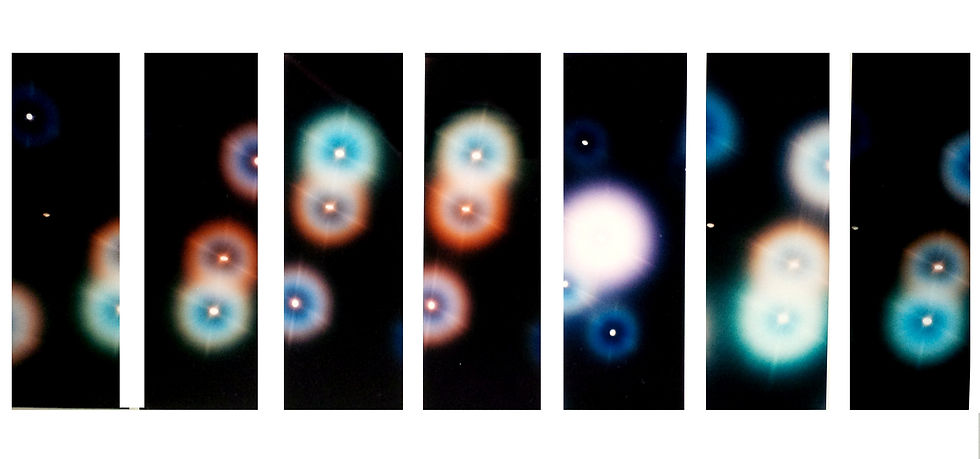
Entitled Kosmos and created by the artist Hervé Saint-Hélier, this exhibition brings together constellations in all their forms.
The photographic prints presented at Sorbonne Artgallery, produced in the secrecy of the artist’s studio, initially evoke Mallarmé and the evocative potential that an image may sometimes carry when it manages to bring us, even slightly, closer to “the power of the starry sky.” This form of elevation recalls not only works connected to the poetics of celestial matter, but also the daily experience of artists and researchers who attempt to give form to the unrepresentable—including scientists who navigate the world of imagery until they acquire the ability to transform a mental image into a photograph (a question also central to certain contemporary reflections on AI).
Saint-Hélier’s work resonates, in counterpoint, with research methods situated at the crossroads of astronomy, chemistry, and biology. It opens perspectives on what it means to be alive here on Earth. A subtle marriage between scientific precision and photographic storytelling accompanies the artist’s gesture on a daily basis and captivates our imagination.
Saint-Hélier’s images harness the power of visual narrative to bring our own discoveries to life and to make immediately accessible a kind of dreamlike knowledge buried within us—like a journey that is both instructive and emotional. An alliance thus emerges between logic and emotion, between scientific rigor and poetic imagery. We unconsciously adopt an innovative form of understanding territory, akin to the approach that formed the foundation of the work of visionary geographer Jean Gottmann, whose research helped shape our understanding of urban landscapes.
Far more than a mere cartographer of the imaginary cosmos, Saint-Hélier captures the complexity of urban imaginaries through his photographs. He transcends borders by offering a unique perspective on urbanism: a multiscalar and cosmic geography of nodes and networks, informed by the luminous and imaginary projections of the peoples who share these spaces as a common habitat.
“In Kosmos, there is no geometry—only stars. My work is created using electrical energy, which I compose through an empirical and phenomenological gesture. Deep within myself, I work in direct relation to the reality of the world’s great metropolises, which manifest mentally from a figurative space. This otherness escapes me, and I perceive only lights and fireflies that map a form of vision of the Earth from the space I inhabit. The constellation as I conceive it is like a reversal of reality, where luminous density set in motion questions me as much as it involves us all, by revealing a share of celestial humanity.”
— H.S-H
Born in France in 1969, Hervé Saint-Hélier began his career as a press photojournalist until 1989, when he decided to devote himself entirely to art. Through his travels around the world, Saint-Hélier captures the natural beauty of details and the singularity of the travelers he encounters. Under his lens, scenes of everyday life are transformed into abstract and poetic compositions.
Exhibited in numerous European and American collections, Saint-Hélier continues his artistic practice while currently living in Paris. His photographic wanderings were the subject of an exhibition entitled Voyage at Marlborough Graphics Gallery in New York in 2008. Abstraction, the cosmos, urban atmospheres, and portraiture are among the many subjects explored by Hervé Saint-Hélier, a renowned French photographer who, from journey to journey, composes a rich and multifaceted body of work. He is represented by Marlborough Gallery in New York.


Humility
of celestial bodies
Stéphanie Sagot
Curated by Paul Ardenne
Exhibition from September 15 to October 4, 2025
Stéphanie Sagot – an art of love at the service of the Earth and the cosmos
Stéphanie Sagot defines herself as "artist, art lecturer, lover of the land and the ocean, meditating and daughter and granddaughter of an oyster farmer. His works address ecology and the love of the Earth from a realistic, didactic and emotional angle. For her, the environment must be approached in a fusional way.
The title of this exhibition, "Humility of the celestial bodies," derives from the etymology of the word "humility," in relation to humus, the nourishing and fecundating earth. As for the evocation of the «celestial bodies», it refers to the great whole, in which we participate on Earth, all organisms included, from the most humble to the most notorious. Stéphanie Sagot specifies, during one of her exhibitions, opened in Stuttgart, at the Pyrohaus, 'Voyage en Terres Amoureuses' (19 July - 30 November 2025): “Since 2023, I have been developing the archpélic work Terres amoureuses, a concrete cosmogony reengaging territories and feelings, earth and tenderness. This 19th-century French expression refers to a land loosened and made fertile [and is] derived from an ancient use of the word 'amour', which defines a fertile land. It disappeared from the French dictionaries in 1928 while intensive agriculture spread and recalls the forgotten importance of the precious organic link to the earth (...). At the time of space ambitions, these loving Lands celebrate Earth and life. They invite us to feel the mystery of the cosmos that inhabits us.
Take care of the Everything and the Here
The plastic works of Stéphanie Sagot take various forms, with this recurrence however, large drawings loaded with multiple details having value of pedagogical boards – a work that she presents in this autumn 2025, at the Sorbonne Artgallery. To evoke, as this artist invites here, the awakening to the natural world, to the wounds suffered by the environment, to the landscape and peasant universe and to the violence recorded against them: this modulation, poetic, is also openly political and concerned, «preoccupied» by the future of the human and non-human world at the time of climate transition.
The vocation of art by Stéphanie Sagot, schematically? Highlight both the very nature of landscapes and the sensitivity that they can activate in us, notably when they are subject to predation or degradation. Artistic expression, in this logic, calls for appeased relationships with the living understood in an expanded way: the terrestrial biotope, of which humans, the mineral, the cosmic, in a holistic perspective, since everything depends on everything. The aim of the artist, supported by related works, inciters, denunciators or worthy of tribute, joins the concern for care, "care": to reshape the world, to make it a more liveable space, to promote the best possible health for everyone and for everything, in the spirit of the "One Health" concept, a common, shared health.
Playing with hypocritical speeches and faux-nez
In parallel with a dynamic personal career dedicated to promoting openness to a better and more ethical world, Stéphanie Sagot created in 2016, in collaboration with Suzanne Husky, the New Ministry of Agriculture, on a simulationist mode and this time, more caustic. «New Ministry of Agriculture»? This institution, in fact, does not exist. The artists have nevertheless brought it to life through a website that looks like a digital portal emanating from the French Republic and significant creations, with an ecological spirit, in this perspective: encourage the visitor to the site to turn back the clock-pile the official proposals when they are hypocritical. Again and in the foutée, suggest this alternative, be wary of or even distrust the official discourse and proposals from above, too often misleading. Among the creations of the New Ministry of Agriculture, let us particularly mention the watercolor series Éléments de langage (since 2022), a painted reproduction of photographs devoted to important figures from the global political world involved in planting trees, as a sign of exemplarity, and posing in front of the photographers – these same figures, Margaret Thatcher, Donald Trump, Nicolas Sarkozy or even Emmanuel Macron... whose action in favor of ecology remains questionable or even deemed unfriendly.
This book, which counters propaganda, is complemented in a different form by L'Aventure du vivant: géoingénierie verte, created by Stéphanie Sagot in collaboration with Suzanne Husky as part of their new Ministry of Agriculture. The adventure of the living: green geoengineering, a 250 x 250 cm watercolor cowhide, is presented in a singular way under the species of an Amerindian bovine skin hanging from a wooden portico. Undisguised evocation of indigenous culture than this one, and in the background, of its ecological wisdom. Equivalent of an educational but anachronistic board, as if shifted in time, this skin is adorned with multiple drawings that refer to current practices or studied by American geo-engineering research centers supposed to support the fight against air pollution, the destruction of soils and environmental impoverishment. Stéphanie Sagot and Suzanne Husky, to create this work borrowed the title "L'aventure du vivant" from a major training plan for future farmers set up by the State, a robotized and mechanized agriculture that resembles a video game... The artists point out all the hypocritical dimension of this program in reality extractivist and signaled by practices more harmful than virtuous for the environment. As Lauranne Germond writes (in the catalog of the exhibition L'eau et le diamant, presented in 2023 at the headquarters of Société générale, in La Défense), this work 'draws up an inventory of these geo-engineering, climate manipulation systems currently being tested in order to combat global warming', even though 'their dangerousness is recognized'.
Amor Mundi
One will detect, in the profuse and multidirectional work to date of Stéphanie Sagot, a multifaceted creation also familiar from art-science relations, mystical thought, and natural sciences – the expression of a humanism not transcendental but immanent, active on the scale of the present, of the near as well as the distant geographical and mental. What to understand? The art thus envisaged cannot be a pure abstraction, a vaporous flow, a flight as far as possible from the current world and its realities and necessities, primarily environmental. On the contrary, it must focus on concrete efficiency. This sensitive commitment is inseparable from a motivated project that in this case drives these two powerful engines, the love of life and the concern for its best possible preservation.
Where art saves, to its measure.
Paul Ardenne


Angels
Ceiling
on my
Eleni Paridi
Curated by Sozita GOUDOUNA (Opening Gallery)
Exhibition from July 8 to August 31, 2025
"What are the odds of seeing angels on your ceiling?
Equal of seeing a landscape within a transparent and colourless stone.
Thus if an unseen landscape is revealed, what happens to the angels on your ceiling?"
Eleni Paridi
Eleni Paridi’s work is an experimental, visual and conceptual exploration of crystalline minerals. His practice explores the idea of memory inscribed in the subject. Since crystals embody the first strata of the Earth’s history, observing their shapes, textures, structures and interiors becomes a ritual for the artist. She approaches the invisible with the qualities of transparency and the dynamics of colored light. What cannot be seen does not imply its inexistence; in her quest for the elusive, she chooses clear quartz and other colorless and transparent stones as the main subjects of her photography. His images evoke a sense of mystery and invite the viewer to an intimate dialogue with geological time and transformation.
“By deepening our gaze beyond the surface, we discover another image that we may never have imagined existed, thus broadening our perception of reality and our understanding.”
Eleni Paridi
With a background in psychology and business administration, Paridi has worked as a graphic designer, artistic director, radio producer, journalist and music critic. Her interest in human nature has led her to explore various approaches to psychotherapy—including psychodrama, family constellations and art-therapy — as well as different holistic energy practices such as Reiki, lithotherapy, among others. Since 2017, the universe of crystals—with its engraved memory and interactive nature — has become the central subject of his photographic exploration. His work has been exhibited in solo and group exhibitions in Syros, Athens, Thessaloniki, Mykonos, New York, Rome, Venice, and soon in Barcelona and Florence. Eleni lives and works between Athens and the island of Syros, in Greece.

home ?
De Babylone en Babylones, de Gulbenkian à Blade Runner
Where is
Arnaud Cohen
Curated by Paul Ardenne
Exhibition from June 20 to July 7, 2025
Meeting with Arnaud Cohen and Paul Ardenne on June 19 at 5 PM
Born in 1968, Arnaud Cohen is a Franco-Portuguese artist who lives and works between France, Spain and Portugal. Presented by Valérie Duponchelle as one of the ten personalities who reinvent culture (Le Figaro, Feb. 2015), he is a member of the Royal Society of Sculptors in London.
Arnaud Cohen confronts his work with his two main obsessions, that of individual responsibility in building collective destinies, and that of a memory between erasure and permanent recomposition. He chose to question the present and the future with tools forged in the materiality of the past. He indeed draws his formal inspiration from architecture and in particular from the practice of reuse. This practice is the only one in his opinion that is satisfactory from an ecological point of view. In the background, the artist refers as much to the Situationists and to Édouard Glissant as to allegories and mythology. His appropriationist practice leads him towards social and aesthetic forms as diverse as a foundation, a dance floor or an assembly of historical remains.


Mythologized origins, otherness and rejection built on invisible criteria, desire to escape towards an idealized haven, movement as the only invariant of an identity in permanent reconstruction. Euphrates, Bosphorus, Tagus. In a finite world, accept in consciousness, a transgenerational awareness, to swim in the same river that is never the same river.
Where is Home? This photographic series holds here in nine photos. Their order does not follow the narration and does not obey an aesthetic ordering criterion of symmetry.
What I write below is neither a statement nor a kind of guide, it’s just true or false leads delivered to the viewers' sagacity.
From left to right in the exhibition, we find the following images, numbered from 1 to 9 :
1 - "My" postcard of Lisbon, photo taken on the occasion of one of my touristic trips there. Discoveries ten years ago when Portugal was considering offering Portuguese nationality to "its Jews" who had fled the Inquisition at the end of the 16th century, the banks of the Tagus instantly powerfully reminded me of the shores of the Bosphorus on which my family, fleeing Spain then Portugal, had taken refuge and established itself until the early 1920s (and the creation of Turkey on the rejection of its minorities and the Armenian genocide).
2 - A view of the Tagus taken from the plane that takes me to Portugal to emigrate there.
3 - October 2016. In my Parisian apartment, dilapidated by several water damages, in the foreground, on the coffee table, arranged in disorder, the different elements necessary for the constitution of my file of Portuguese naturalization. Family trees, identity photos, blank French civil status locker, French passport, etc. In the background at the center right of the image, we see the white sofa with blue cushions from my conceptual work ASFI, hub with airport spirit where international curators meet to exchange and build a support network in a world where the freedom of demonstration is constantly declining (migrant work deployed at the Akart biennales, in Cairo, BIENALSUR in Buenos Aires and Venice with Switzerland, but also at the Tate St Ives and presented at the Pompidou Centre as part of Museum on/off). On the back wall, a photo of this same room while the Blade Runner film is projected onto the back wall. Mise en abyme. Chosen moment of the film: a replicant, human being created as an adult in a laboratory by the scientific genius and tycoon of tech Eldon Tyrell. Slave of the "colonies of space" like all replicants, she escaped with some companions. Their goal in returning to Earth where they were created: to meet Tyrell so that he extends, they hope, their programmed lifespan to four years. They only have a few days left to live.
4 - October 2016. In my Parisian apartment, projected on the back wall of my living room, Blade Runner. This photo captures the moment in the film when Pris, arriving on earth in Los Angeles, tries to get in touch with JF Sebastian, Tyrell’s right hand man. To cajole him, get hosted by him and use him to meet Tyrell. she is about to announce to him in the following sequence: "I have no home".
5 - I found my new home. To fit into my budget, I had to take a risk: buy a walled property without knowing either the interior condition or the content. When I finally enter it, armed with a crowbar and a big screwdriver, I discover that the lieumuré was a squat where prostitution and drug taking took place on soiled mattresses in rooms with a gutted ceiling. On the ground, a multitude of vestiges of this previous occupation, miserable. Other migrants infinitely more to be pitied than me had found refuge, slave labor and forgetting an unbearable present, within these walls.
6 - October 2016. Still in my old Parisian apartment, projected on the back wall of my living room, Blade Runner. This photo captures another moment of the film: we are at JF Sebastian’s place. JF is a young man who seems very old because he has Methuselah syndrome. Due to his illness, he is one of the few young men who did not leave Earth for space. Condemned to never be able to leave LA, he lives alone in a building whose degradation, the neoclassical remains and the light echo mine so well that the two spaces seem to merge. On my side, carrying within me centuries of migrations, I seem as old as Methuselah in the body of a young man.
7 - October 2016. Still in my old Parisian apartment, projected on the back wall of my living room, Blade Runner. This photo captures another moment of the film: we are at Rick Deckard’s in Los Angeles. In his apartment there are many family photos which constitute a form of genealogy. Deckard is a hunter of replicants as there were in Europe hunters of Jews during the Nazi period. His mission is to track them down and eliminate them. In this sequence, he analyzes a souvenir photo of a replica that he is hunting. There is therefore, as in photo number 3, for the viewer who tries to analyze the image offered to him, a mise en abyme of a photo of a photo itself analyzed by Deckard. At the end of the film, we will learn, with this latter, that he is in fact himself “even a replicant who ignores himself. To better manipulate him, Tyrell has indeed implanted in Deckard’s brain the childhood memories of a human.
8 - From my new home in Lisbon, far from the ideal view of the postcard of my dreams, I can nevertheless, from one of my windows, provided that I hoist myself on tiptoe, guess more than see, through the foliage of trees, the Tagus and a small fragment of the other shore.
9 - The district of Pera in Constantinople, view of the Bosphorus (Tophana pier). Engraving of 1838, drawing by Thomas Allom, engraver J. Sands. From the book Constantinople and its Environs, by Robert Walsh. By its hills that border it, by its width, by its light in summer, by its bus boats that go from one bank to another, the Tagus inevitably makes think of the Bosphorus to which it comes. It was for me as much a shock as an evidence because during my childhood and adolescence I went several times to Istanbul to meet the first cousins of my father and their children. It was in Lisbon during my first trip that I discovered the existence and journey of Calouste Gulbenkian. Armenian billionaire from Constantinople, he fled the genocide and takes refuge with his immense fortune and his exceptional art collections in Paris. My family, considering that the fate reserved for the Armenians by the Turks is only the appetizer, and that Greeks, Kurds, and Jews will be next to be exterminated, makes the same journey. When the Nazis arrive in Paris twenty years later, in 1940, if my family does not have the means to flee, Gulbenkian takes refuge in Vichy and then in Lisbon, in 1942. Immediately captivated by the similarity between the landscape of the Tagus and that of the Bosphorus, he settled there and died in 1955. He leaves his immense collections to a foundation that today bears his name.
Arnaud Cohen

HyperFard
Prix AMMA 2025
Lou Reina,
Exhibition from June 4 to 19, 2025
Born in Paris in 2000, of a Spanish father and a French mother, Lou Reina lives and works in Paris. Graduated from the Beaux-Arts de Paris in 2024 from the Tatiana Trouvé workshop, she went through a 6-month university exchange at the IUAV di Venezia University (2022). She took part in several group exhibitions including CRUSH (2023) and Autobillets (2024) at the Palais des Beaux-arts de Paris. Winner of the Paris 1 Sorbonne Jury Prize for Contemporary Art 2025, it is in this context that her personal exhibition at the Sorbonne ArtGallery takes place. His artistic practice explores the intersection between drawing and ceramics in identity-driven, dreamlike narratives that are constantly renewed.
_jp2.jpg)
Photo : Ix Dartayre
This series of masks, initiated almost two years ago, accompanies the artist on a daily basis and evolves over the references, images and technical explorations that pass through it. He draws himself as a multifaceted character embodied by the masks as if each one carried within him a story, even the possibility of a performance. For the exhibition Hyperfard at the Sorbonne ArtGallery, each showcase becomes a miniature theatre, surrounded by a ceramic mask with exaggerated and ambiguous features, which seem to float in space as if suspended between two states. The intersection of the stage space and that of the exhibition is the starting point of this proposal. These sculptural presences, deployed in monumental dimensions, impose themselves as frozen figures waiting for a role. The installation plays with the border between the sculptural object and the decor, between the theatrical device and the museum display.
Masks as tools of transformation and self-determination allow the wearer to transcend individuality and inhabit a hybrid, theatrical character. Both inspired by burlesque, exacerbated codes of drag with its ability to play with identities, and to mix genres but also of older theatre; these masks navigate between different temporalities and perhaps give the sensation of an ambiguous presence captured by enamel.
These faces are surfaces for the projection of multiple narratives through which the power of makeup is replayed—make up, conceal, perform. The title Hyperfard condenses the essence of this research: make-up as an excess, as a political and aesthetic surface, as a gesture of radical transformation. It evokes a makeup pushed to the extreme, beyond camouflage, up to the manifesto. The 'hyper-' is not only amplified: it suggests an assumed overload, a fiction more true than reality.
For Lou Reina, ceramics and drawing are interwoven in a poetic narration where anachronism becomes matter and narrative. The memory of everyday objects, the traces they leave in our unconscious imaginations are the starting point for an individual or even fictional narrative that gradually becomes collective. The sculptures evoke forms known to all, yet unusable. These are still lifes, assembling objects where nothing is left to chance as if each detail retained the imprint of an instant, of an unknown will. On all the sculptures, a spectral figure hangs, between fallen star of the roaring twenties and fictitious double without ever being explicitly represented.
It is created as a language of rebus, a formal vocabulary, stemming from the symbolic and baroque field, mobilized both in still lifes and in drawings. Intimate objects seem frozen under vitrified layers of enamel, clothes encrusted with charms and accumulations of lost fragments - game pieces, keys, escarpin or bucket -, evoke the testimonies of a life of bringue at the cabaret.
Temporality is blurred; the very materiality of heavy and static ceramics invites us to question its meaning and origin, as if it came from a parallel world or from a distant time. These ceramics carry within them the trace of a sometimes accidental process. The break crosses the work, exposing its fragile nature and making resonate a founding gesture, that of drawing, which, from paper to ground, moves from sketch to tattoo of matter.

Exhibition "ID"
Angelica Dass
Márcia Charnizon,
et Juliana Sicoli
Exhibition from April 10 to May 31, 2025
As part of the France Brazil season, Sorbonne ArtGallery, in partnership with Initial LABO, presents three Brazilian women photographers, whose vision of identity is expressed through the choice of a chromatic palette as a subliminal lever for messages.
ID, for “identity”, is an exhibition of three series featured in the collection “Un fonds photographique brésilien à la BnF”: Márcia Charnizon, Angelica Dass and Juliana Sicoli.
In the history of photography, the struggle to impose color at a time when visual aesthetics were dominated by black and white is, in a way, linked to demands for a role for women in society. The “Goddesses” series by British photographer Madame Yevonde (1893-1975) from the early 1930s is a case in point, with its innovative use of color, then scorned or confined to advertising. The three Brazilian artists gathered here have in common that they combine their chromatic choices, oscillating between softness and violence, with embroidery, the Pantone grid or word-hunting games. In their feminist and, more broadly, humanist approach, it's less important to document than to make an image, and their creative choices help to denounce inequalities in relations between men and women, as well as between the various black, Amazonian and white communities that make up Brazil.
Juliana Sicoli, trained in psychoanalysis alongside her studies in photography, weaves a unique narrative in her “Ainda Assim Falo” (I'm still talking) series, interweaving archival images, paintings and cutting and sewing interventions. Through gesture and chromatic play, she seeks to excavate the surface of appearances and images to reveal deeper traumas.
For her “Humanæ” project, initiated in 2012, Angelica Dass catalogued the portraits of 4,000 people in 17 countries and 27 cities around the world, regardless of age, religion, nationality, gender or social class, photographed according to the classic standards of anthropological photography and legal portraiture (bust framing, frontal pose and lighting). She thus establishes a kind of “human palette” highlighting the diversity of skin tones in the manner of a Pantone color chart, but also enhancing the subtle continuity of our colors afin to create more equality than difference.
As for Márcia Charnizon, in “Caça as palavras” (The Hunt for Words), she seeks to expose the violence of words spoken against women. Here, she brings together women over 50, protagonists of their own stories, who, in a red lighting similar to the inactinic light of a silver laboratory, show the marks that stigmatizing words have left on their naked bodies.
For these three artists, the questioning of normative representations made possible by color and the hybridization of photography with other media encourage new ways of committing to the recognition of human beings in all their diversity.
Héloise Conesa, Heritage Curator, in charge of the contemporary photography collection at BnF's Département des Estampes et de la Photographie.
If not now, when ?
Kate Daudy
Curated by Flavia Nespattidu
Exhibition from March 1 to 28, 2025

Pour accéder au catalogue,
scanner le QR code.
Kate Daudy is a conceptual artist known for her public interventions, large-scale sculptures and experimentation with language. She has long collaborated with scientists and thinkers in many media. Although disturbing, his multifaceted work remains imbued with optimism. The current circumstances of the world may seem disastrous, but Daudy emphasizes that the future is in our hands. His work will be the subject of a retrospective at Sorbonne ArtGallery which will open its doors on February 28, 2025. Daudy will give a series of lectures "Amor Mundi" to accompany the exhibition: "Interventions As a Medium : Written interventions and Impermanent installations 2018-2024", "Advocacy, the environment and sustainability : Experiments with new technology and new materials", "Art + Science : Illustrating, advancing and exploring scientific ideas through artistic practice".

Lectures
"Interventions as a Medium" traces the origins of Daudy’s work in using words as a sanctuary by sewing them and writing them all around her, through the ancient Chinese practice of writing on objects she learned, to her interventions in public spaces. Daudy’s innovative city-wide projects and interest in the symbolism and active power of art is rooted in ancient cave paintings and ritual practice. Daudy’s work “Am I My Brother’s Keeper?” is covered and filled with words and placed not just in museums and public spaces but also in town squares, a supermarket, a theatre and even Saint Paul’s Cathedral in London. The work was eventually placed on the national curriculum in Spain. The lecture shows how humankind’s long tradition of public art has the capacity to convey ideas and imbue a space with narrative, in Daudy’s case, a narrative of community, empowerment and resilience.

“Art and Science” looks at the various works created by Daudy with scientists and medical practitioners. The artist has a longstanding collaboration with Nobel Prize winning scientist Kostya Novoselov which has led to a variety of works including the use of new materials, digital technology, sound and film work, installations and performance pieces. Their exploration of randomness and chaos led to the book Wonderchaos. Daudy has also worked with Hammersmith Hospital in London on a film for her Saatchi exhibition “It Wasn’t That At All” and currently with biologists recreating ink from a 7500 year old ancient Egyptian recipe, as well as sound engineers at the IRCAM here in Paris on recording honey with electrodes.

"Advocacy, the environment and sustainability" looks at Daudy’s highly conscientious and often labour-intensive repurposing of found objects and everyday materials into art work. The artist combines the use of new technologies and materials with natural materials like a fallen tree or honey gathered from the Cloud Forests of Bolivia. Her political care and attention to sustainability led her to create a body of work for a university in Kuwait entirely sent over in digital files. She even 3D printed sculpture combining sand with resin and disassembled the work upon her departure. Her installation for Glastonbury will slowly grow over the years: here the artist worked with a group of refugee women to create a meadow of handcrafted flowers symbolising the community and environmental values of the festival. Her upcoming museum show “Telling The Bees” explores man’s relationship with history and the natural world through the prism of honey. Her work fosters dialogue between themes of ecology, community, and the divine, inviting the viewer to consider everyday decisions in a broader context.


toujours premiers
Les arts sont
Hervé Fischer
Exhibition from December 4th 2024 to January 18th 2025
Patrick Rimoux is a light sculptor. Light is his element, his substance, his work, which he shapes and enchants. Since childhood, he has been fascinated by shapes, volumes and materials: he experimented with many of them before turning to the art of light. So, after training as a teacher of new technology, he went on to study at the Beaux-Arts in Paris, notably in the studios of Claude Viseux and Piotr Kowalski. With them, Patrick Rimoux unleashed his creativity and embarked on a passionate exploration of light: cinema, photography, architecture, painting, sculpture... light is everywhere and essential. From then on, he set about bringing light to life, making it palpable and a messenger of emotions.
In the 1990s, he founded the Patrick Rimoux Agency, tried his hand at a number of projects and seized the opportunity offered by Belgium to work on large-scale programs. Since then, from the Grand-Place in Brussels to the Freedom Towers in Johannesburg, from the Palais de Jaïpur and the Centre de la Francophonie in Quebec City to the French Embassy in New Delhi, from Geneva to French Guiana via the Abbey of Dourgne, from the Art Basel fair to the facades of the PS1/MOMA and the Payne Whitney mansion in New York, from the Gare du Nord in Paris to the parliaments of Brussels and Notre Dame in Paris, the agency has been working on architecture all over the world for 35 years. We produce both permanent creations and exceptional, ephemeral events. We draw on walls or make entire districts vibrate. She magnifies the sculptures of other artists and architects (Kengo Kuma, Franck Gerry, Sou Fujimoto, Jean Marie Duthilleul, Nicolas Michelin, Richard Texier, etc.) or composes her own works in galleries such as Minsky Paris, Weinstein San Francisco and Akar Prakar New Delhi.
Insatiable, curious, open-minded, a lover of history and culture, Patrick Rimoux is teeming with ideas and tirelessly questioning himself. However, one thought - like a leitmotif - remains eternally anchored in him: to produce wonder through light, in order to touch the deep and spiritual in everyone.

